

Predictive Maintenance · PROCESS INDUSTRY · MANUFACTURING
Keep pasteurisation running within food-safety tolerance — without unplanned stops.
Heat exchanger fouling, pump wear, scale build-up and cooling-system drift slowly degrade pasteurisation efficiency and threaten product safety — and dairy plants run continuously, so unplanned downtime is expensive. The XMPro AO Platform monitors HTST and batch pasteurisation telemetry continuously, predicts the failure modes that matter, and schedules maintenance before quality or compliance slip.
What's getting in the way today.
Pasteurisation reliability is a food-safety problem as much as an asset problem. Seven pressures compound:
Continuous wear
Pumps, homogenisers and heat exchangers degrade steadily under continuous operation — failures arrive as drift, not as alarms.
Heat exchanger fouling
Milk fouling and scale build-up reduce heat transfer efficiency, lengthen hold-time and lift energy use long before any single sensor reports a fault.
Quality variability
Equipment performance drift produces inconsistent pasteurisation, threatening product specification and shelf life.
Reactive maintenance overhead
Without continuous telemetry, maintenance is calendar-driven or reactive — both expensive against continuous-flow dairy operations.
Energy cost
Pasteurisation is energy-intensive, and per-asset baselines are needed to spot inefficiency hiding in the aggregate bill.
Regulatory tolerance
Strict temperature and hold-time requirements leave no room for equipment drift to push the process out of tolerance.
Cooling-loop failures
Inadequate post-pasteurisation cooling compromises microbial safety and shelf life — a different failure mode from the pasteurisation step itself.
Pasteurisation Predictive Maintenance — how it works.
Continuous telemetry across pasteurisation, separation, fermentation and homogenisation — fed into predictive models that target the specific failure modes of each asset class, with maintenance scheduled before quality drifts.
The platform integrates temperature, flow rate and pressure data continuously across pasteurisation equipment — shell- and tube-side temperatures on heat exchangers, pump discharge pressure, motor current, hold-time at temperature. ML models target the specific failure signatures of pasteurisation: milk-fouling prediction on heat exchangers, pump-efficiency decline, motor current anomalies. A digital twin simulates pasteurisation operation under different conditions for scenario analysis. Threshold breaches generate ranked recommendations with severity, parts and crew attached, with work-order creation flowing into the CMMS. Operators see live multi-plant asset health, per-asset drill-down with telemetry trends and predicted RUL, and the dashboard surfaces alerts ranked by criticality so quality-sensitive interventions get priority.
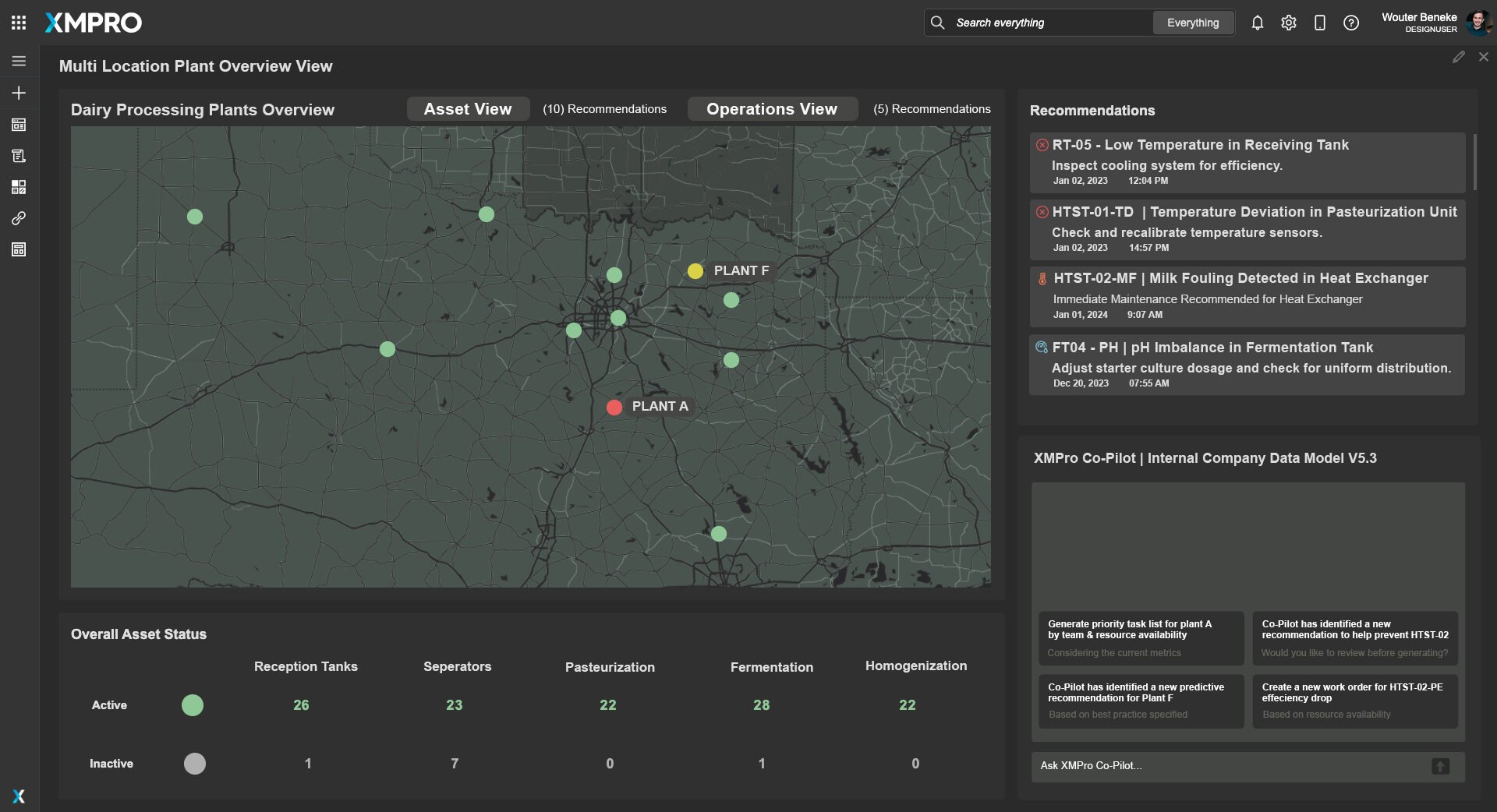
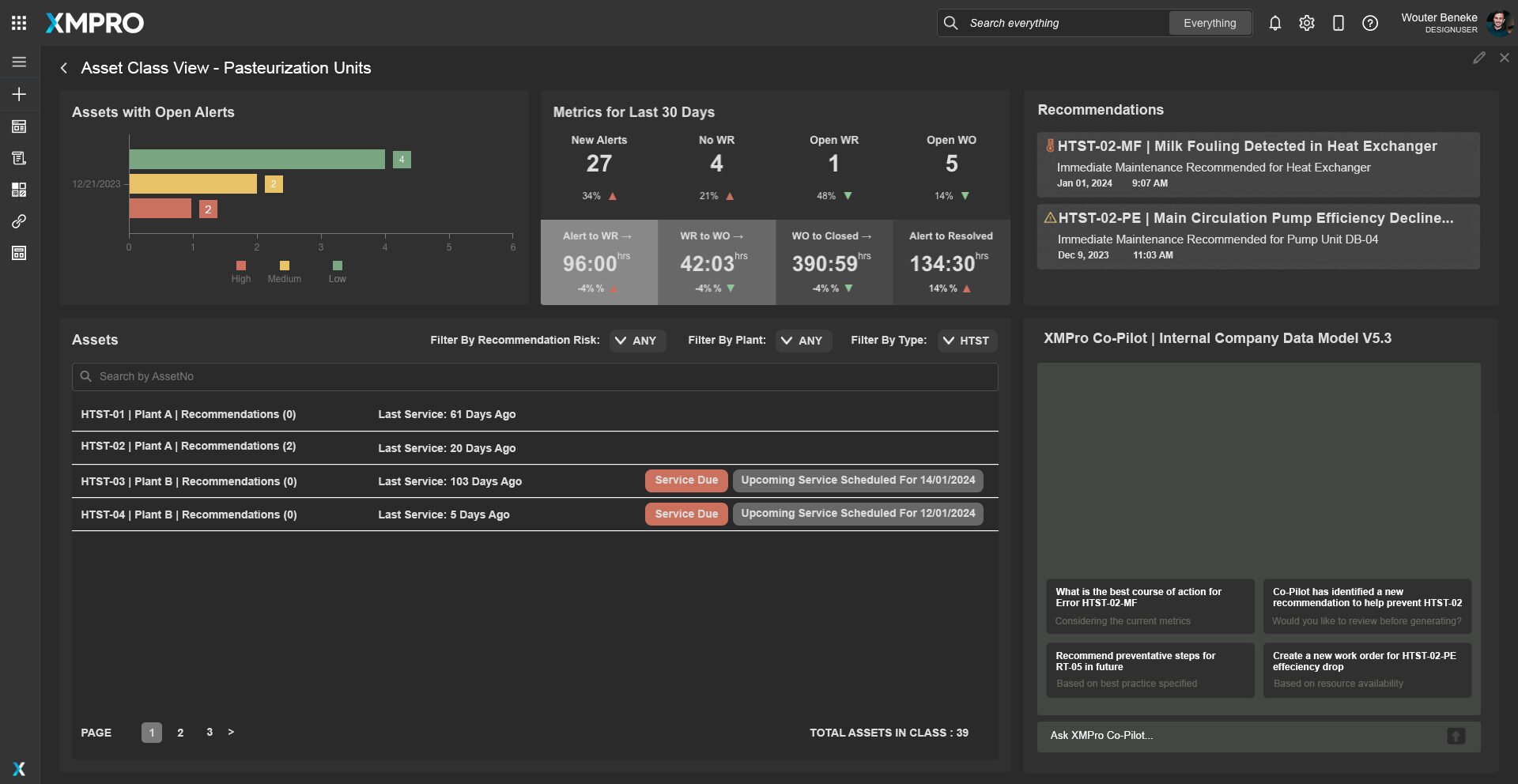
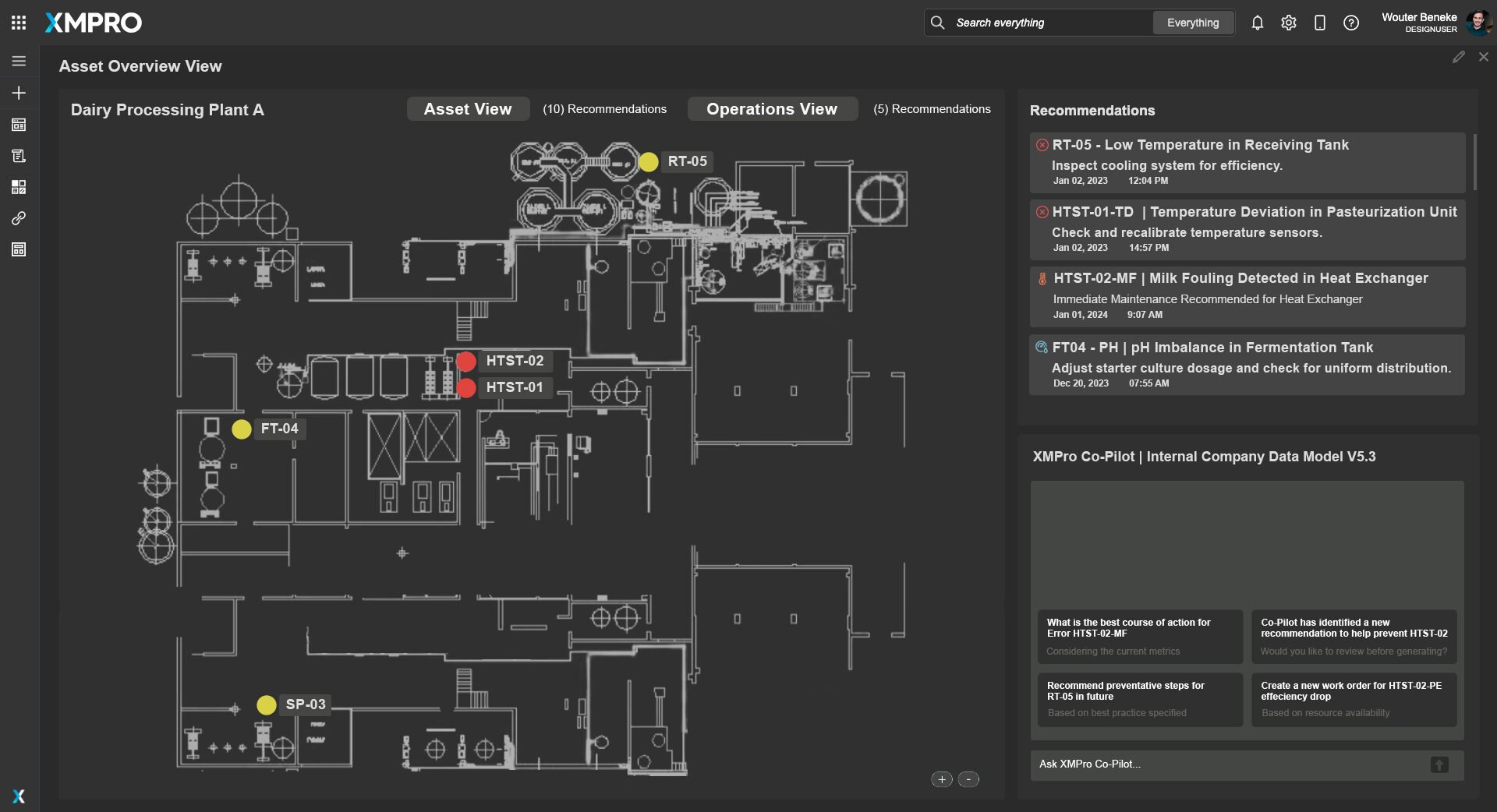
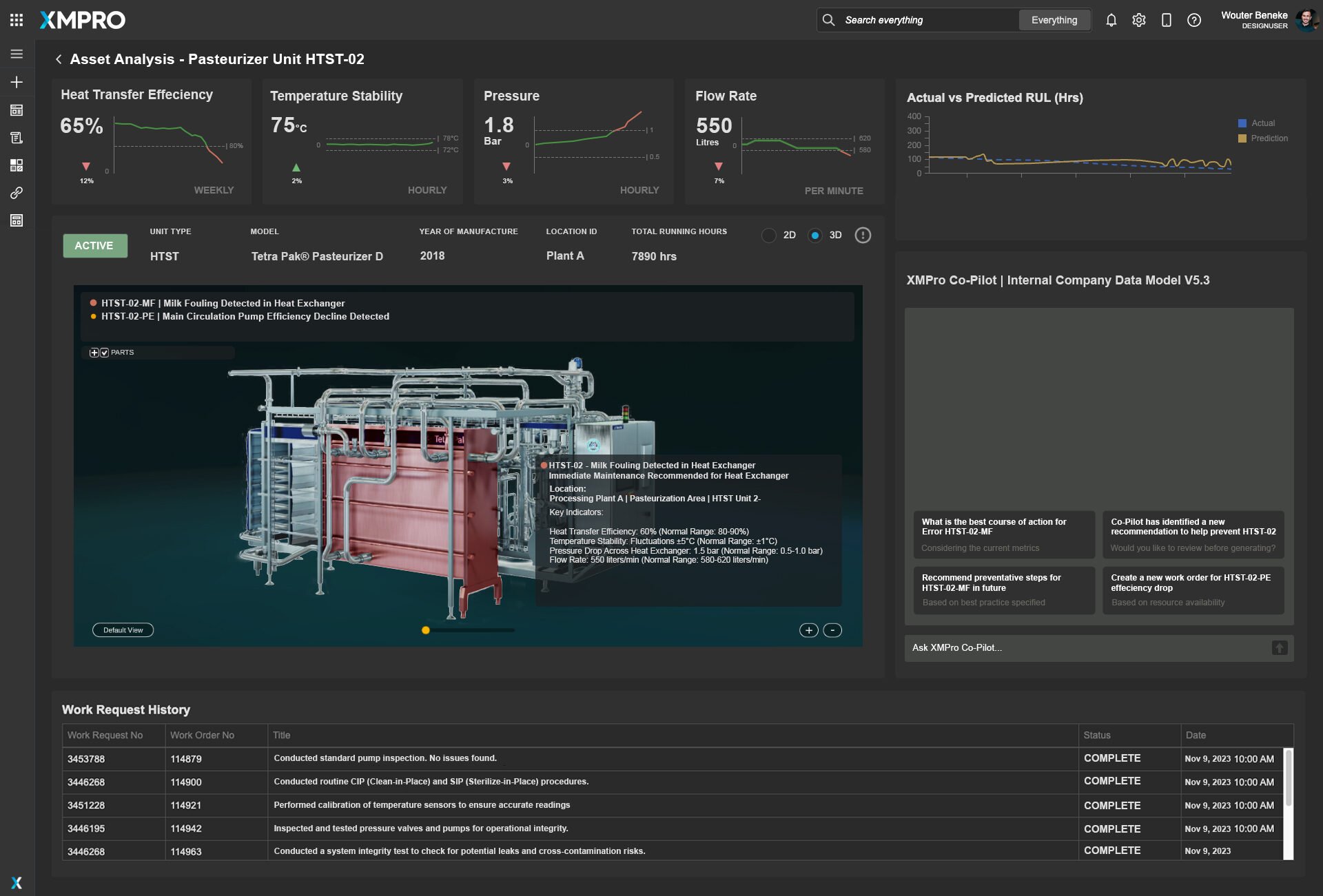
*Illustrative dashboards from the platform. Layout, signals and decision points are scoped per site.
Scope this for your operation.
Tell us about your fleet, your control maturity and the lever that matters most. We’ll map this use case to your starting point.
What this looks like in operation.
Quality protected from equipment drift
Predicted heat-exchanger fouling and pump-efficiency decline are caught before they push pasteurisation outside specification.
Maintenance into planned slots
Continuous flow operations stay continuous because maintenance moves into planned windows ahead of failure.
Multi-plant consistency
A single condition view across plants standardises maintenance practice and surfaces best-performing sites for benchmarking.
Built for these industries.
Other solutions you might explore.
Not a concept. In production.
XMPro is deployed at Tier 1 global operators across asset-intensive and mission-critical industries — delivering measurable results across predictive maintenance, process optimisation and operational intelligence.
Now pushing the frontier.
MAGS agents are achieving what no other industrial platform has demonstrated — sustained autonomous operations at enterprise scale.