

TARGETED OUTCOME
30-50% Reduction in unplanned conveyor downtime Condition Monitoring · MANUFACTURING
Conveyor belts that flag failure before they cause it.
Continuous operation wears belts, motors and rollers in ways fixed-interval schedules never catch. The XMPro AO Platform monitors every conveyor in real time, predicts the failure mode, and optimises energy use across the assembly line — without disrupting production.
What's getting in the way today.
Conveyor belt systems sit at the heart of automotive assembly. When they stop, the line stops. When they degrade quietly, the line slows. Four pressures compound:
ISSUE 01 OPEN
Wear and tear
Continuous operation degrades belts, motors and rollers. Failures arrive as unexpected stops, not as scheduled events.
ISSUE 02 OPEN
Unpredictable failures
Fixed-interval maintenance either over-services healthy assets or misses degradation that’s already underway. Both outcomes are expensive.
ISSUE 03 OPEN
Operational inefficiencies
Belt misalignment, tension drift and speed variance go unnoticed without continuous telemetry — quietly eating throughput and quality.
ISSUE 04 OPEN
Energy consumption
Conveyors are major plant energy consumers. Without per-asset baselines, inefficiency hides in the aggregate utility bill.
Conveyor Belt Monitoring & Optimisation — how it works.
A unified view of every conveyor on the line — fed by the sensors already on the assets, governed by the platform’s safety architecture, and surfacing the failure modes that matter before they take the line down.
Real-time data integration Predictive analytics Anomaly detection Automated recommendations Operational dashboards Digital twin simulation
How it works
The platform integrates vibration, motor current, voltage, temperature, acoustic and network-integrity sensor data continuously across every conveyor. ML models analyse this telemetry to predict remaining useful life and surface specific failure modes — bearing wear, motor efficiency drop, belt misalignment, electrical fault patterns — with confidence scoring. A digital twin lets reliability engineers test interventions virtually before changing anything in production. Threshold breaches generate ranked maintenance recommendations with parts list and crew assignment, feeding directly into work-request creation.
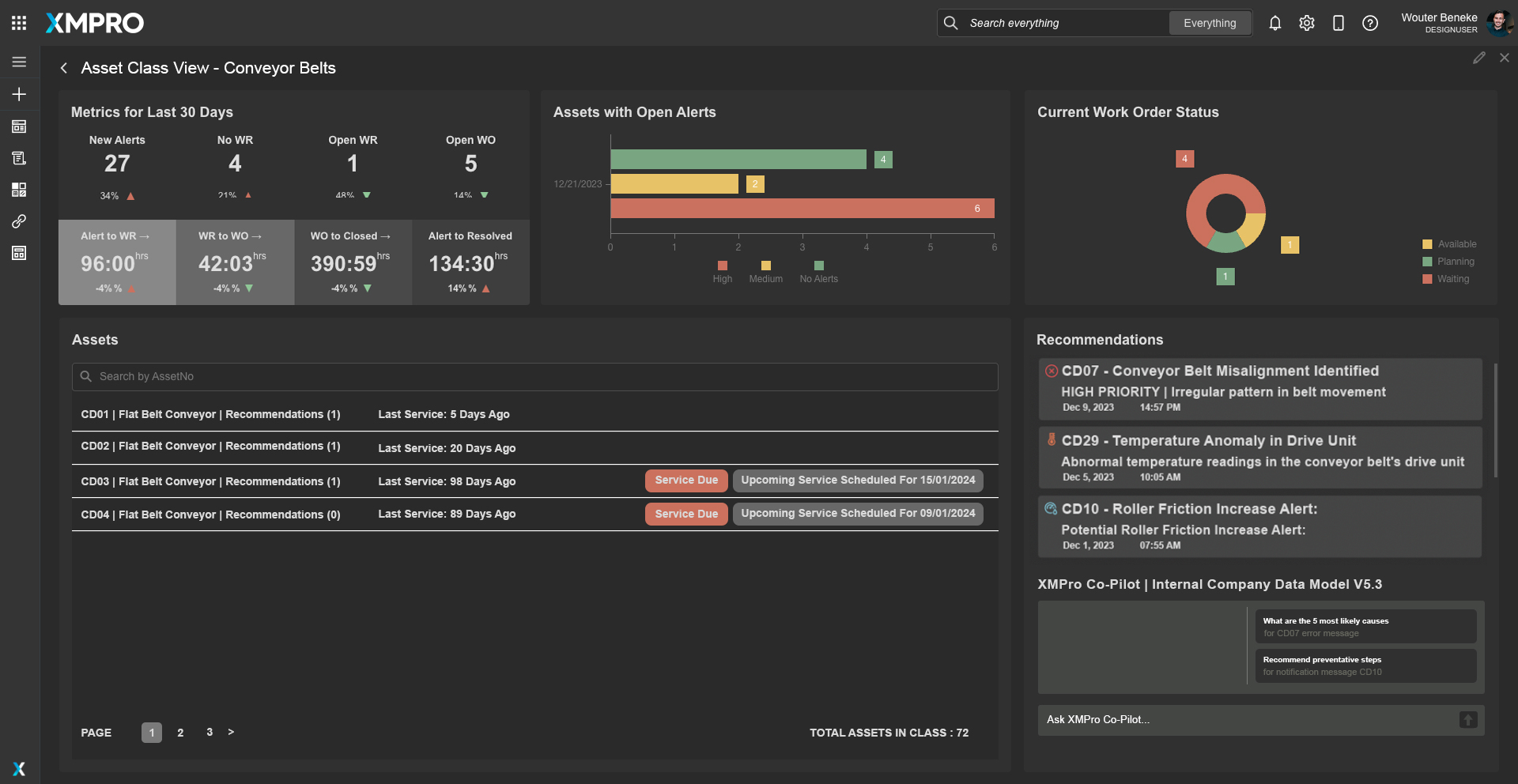
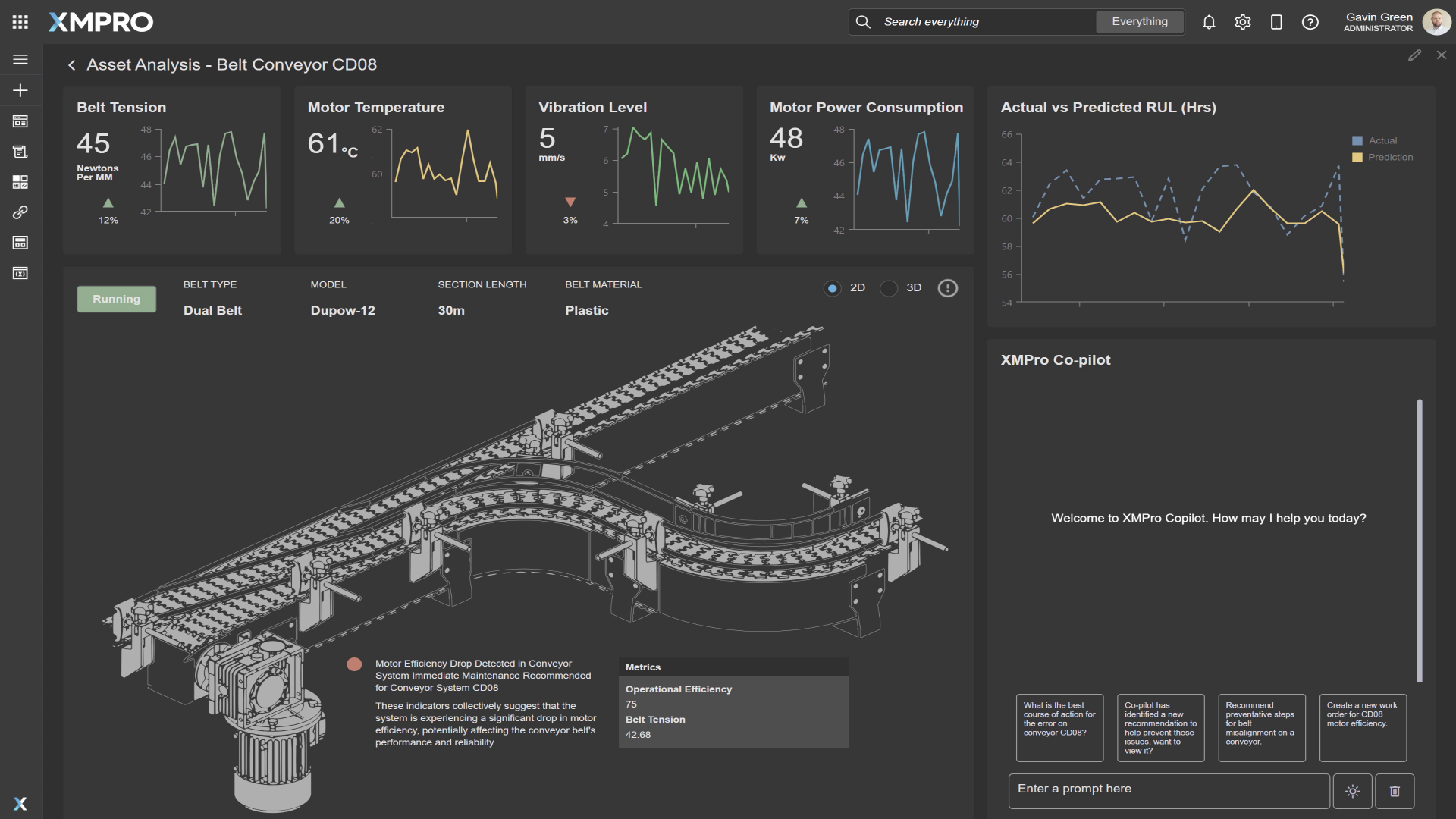
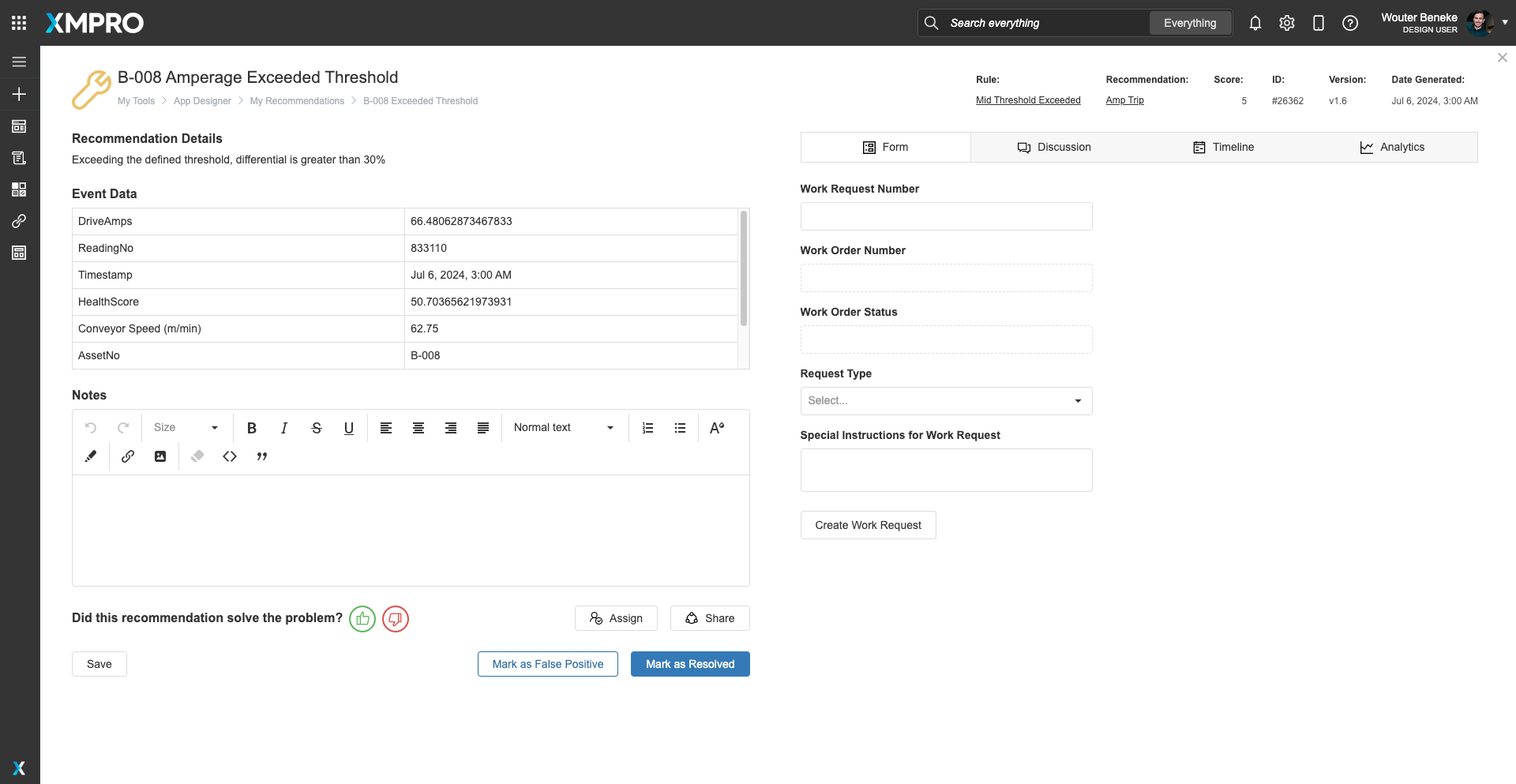
*Illustrative dashboards from the platform. Layout, signals and decision points are scoped per site.
Scope this for your operation.
Tell us about your fleet, your control maturity and the lever that matters most. We’ll map this use case to your starting point.
*Indicative ranges from industry research and customer engagements · actuals vary by site, control maturity and starting baseline.
What this looks like in operation.
Predictable uptime
Failure modes surface days before stoppage, so the line plans around interventions rather than reacting to them.
Right-sized maintenance
Work moves from the OEM calendar to the asset’s real condition, freeing crew time for higher-value tasks.
Lower energy cost
Per-asset baselines turn the energy bill into a leverable line item, not just a sunk cost.
Built for these industries.
Other solutions you might explore.
Not a concept. In production.
XMPro is deployed at Tier 1 global operators across asset-intensive and mission-critical industries — delivering measurable results across predictive maintenance, process optimisation and operational intelligence.
Now pushing the frontier.
MAGS agents are achieving what no other industrial platform has demonstrated — sustained autonomous operations at enterprise scale.
15+
Days Autonomous
Safety-critical petrochemical operations
3-5+
Agents Per Team
Specialized agents coordinating per use case
50+
Teams Deployable
Scale across sites and business units
100%
Governed
Every agent, every decision, every action, auditable