
Condition Monitoring · MANUFACTURING
Hydraulic systems that warn you before fluid loss takes the line down.
Hydraulic systems fail in ways the OEM calendar never catches — a slow fluid leak, a pressure anomaly, a temperature climb that signals seal degradation. The XMPro AO Platform monitors every hydraulic system in real time, flags the failure mode, and routes ranked recommendations into work-request creation across the plant.
What's getting in the way today.
Hydraulic system reliability shapes throughput and safety alike. Four pressures compound:
Quiet fluid loss
Low fluid levels and seal degradation develop between scheduled checks — catastrophic failure arrives without warning if no continuous monitoring exists.
Reactive maintenance
Calendar-driven service either over-services healthy systems or misses degradation already underway — both cost throughput and crew time.
Fragmented telemetry
Pressure, temperature, fluid level and flow rate live in separate systems — the correlations that predict failure go unseen because no one fuses the streams.
Safety exposure
Hydraulic systems running outside safe limits create personnel and contamination hazards that grow until they’re caught manually.
Hydraulic System Condition Monitoring — how it works.
A zone-based view of every hydraulic system in the plant — fed by the sensors already in service, with ranked recommendations feeding directly into work-request creation.
The platform integrates pressure, temperature, fluid level and flow-rate data continuously across every hydraulic system. ML models analyse this telemetry to predict failure modes — low fluid levels, abnormal pressure profiles, temperature anomalies, seal degradation patterns — with threshold-driven alerting and confidence scoring. A zone-based dashboard surfaces colour-coded system status across factory zones, and per-system drill-down shows live metrics, recent alerts and historical trends. Threshold breaches generate ranked recommendations with event data, parts list and special-instruction notes, feeding directly into work-request creation across email, Microsoft Teams and the alert dashboard.
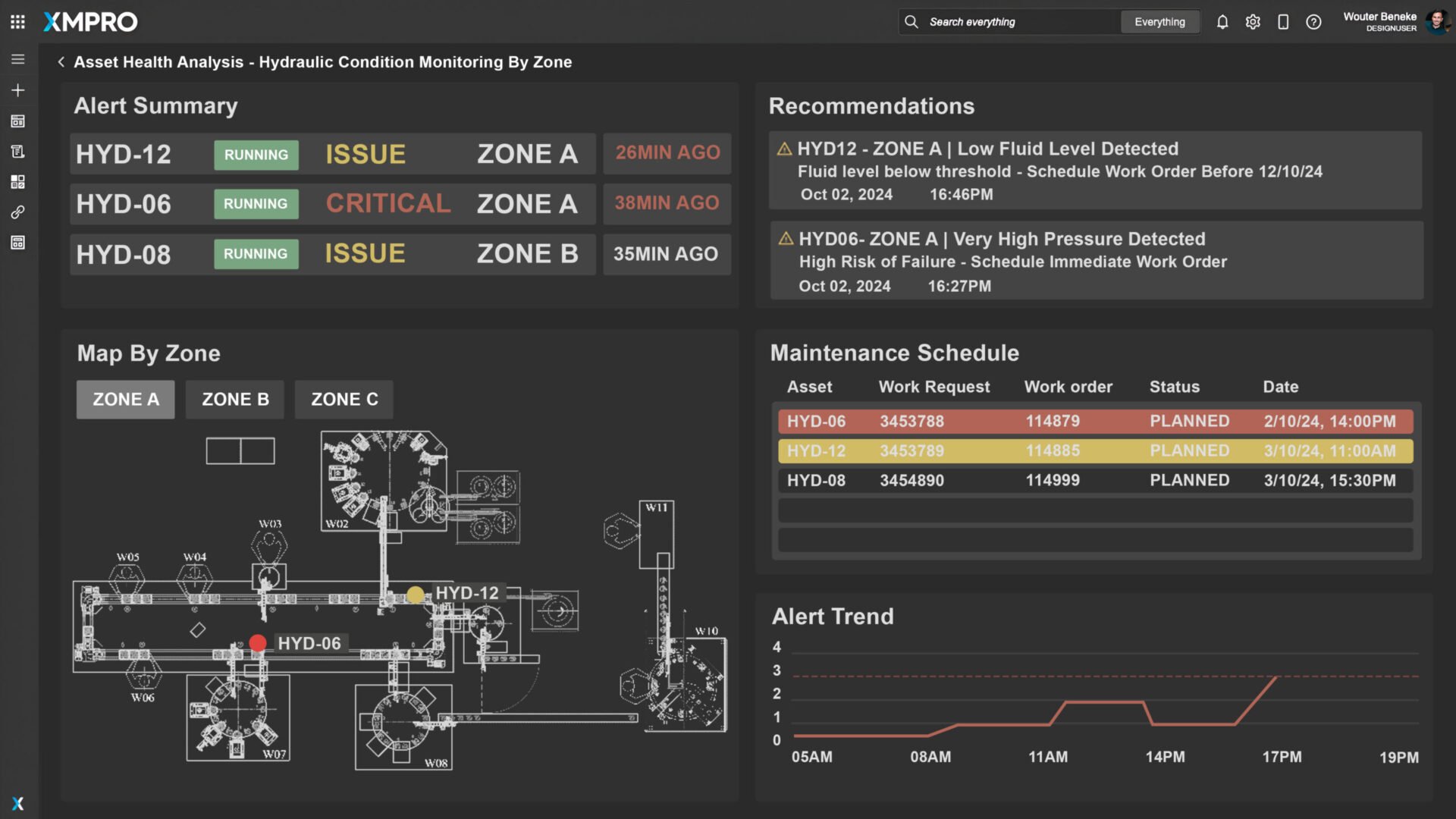
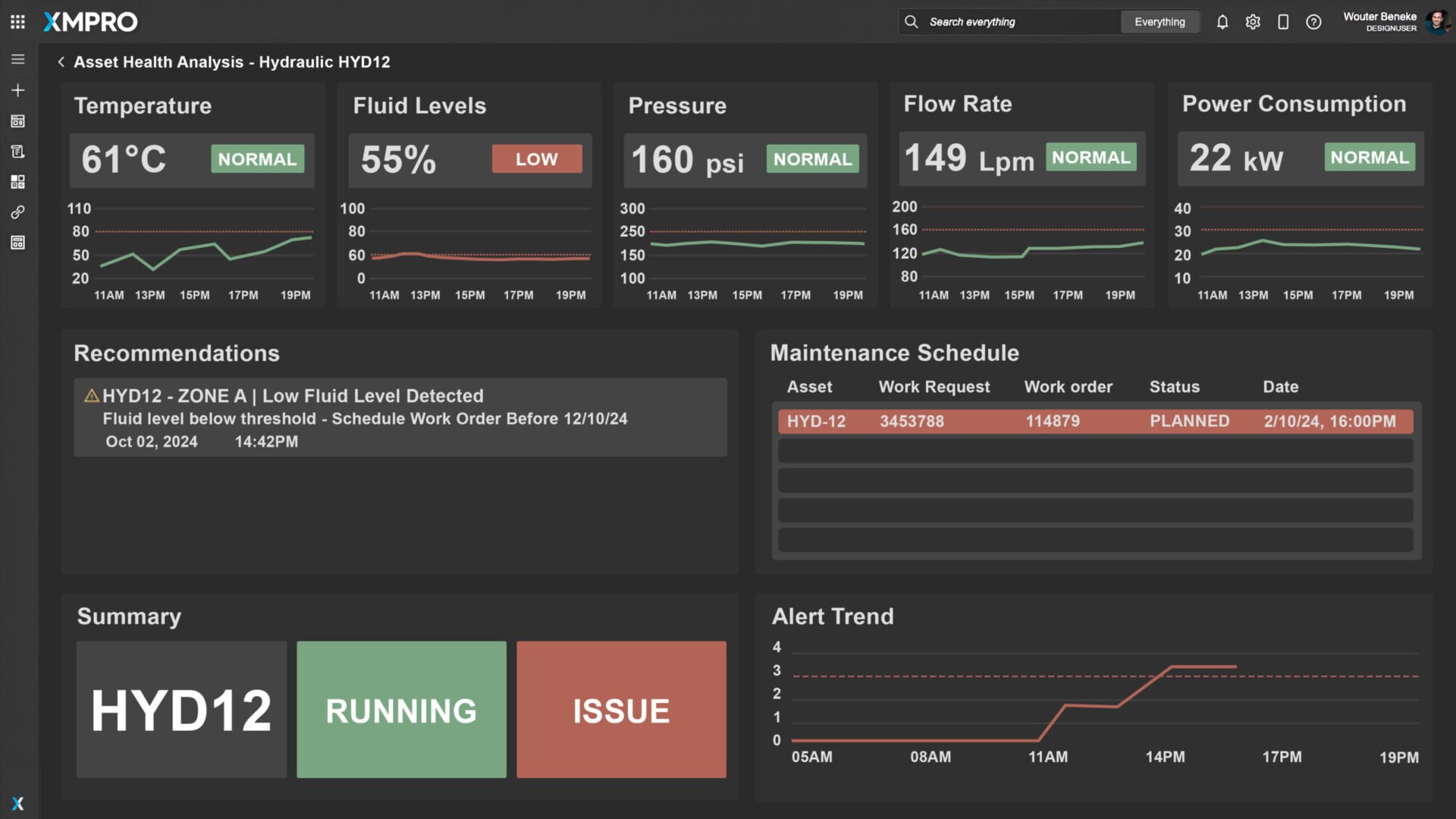
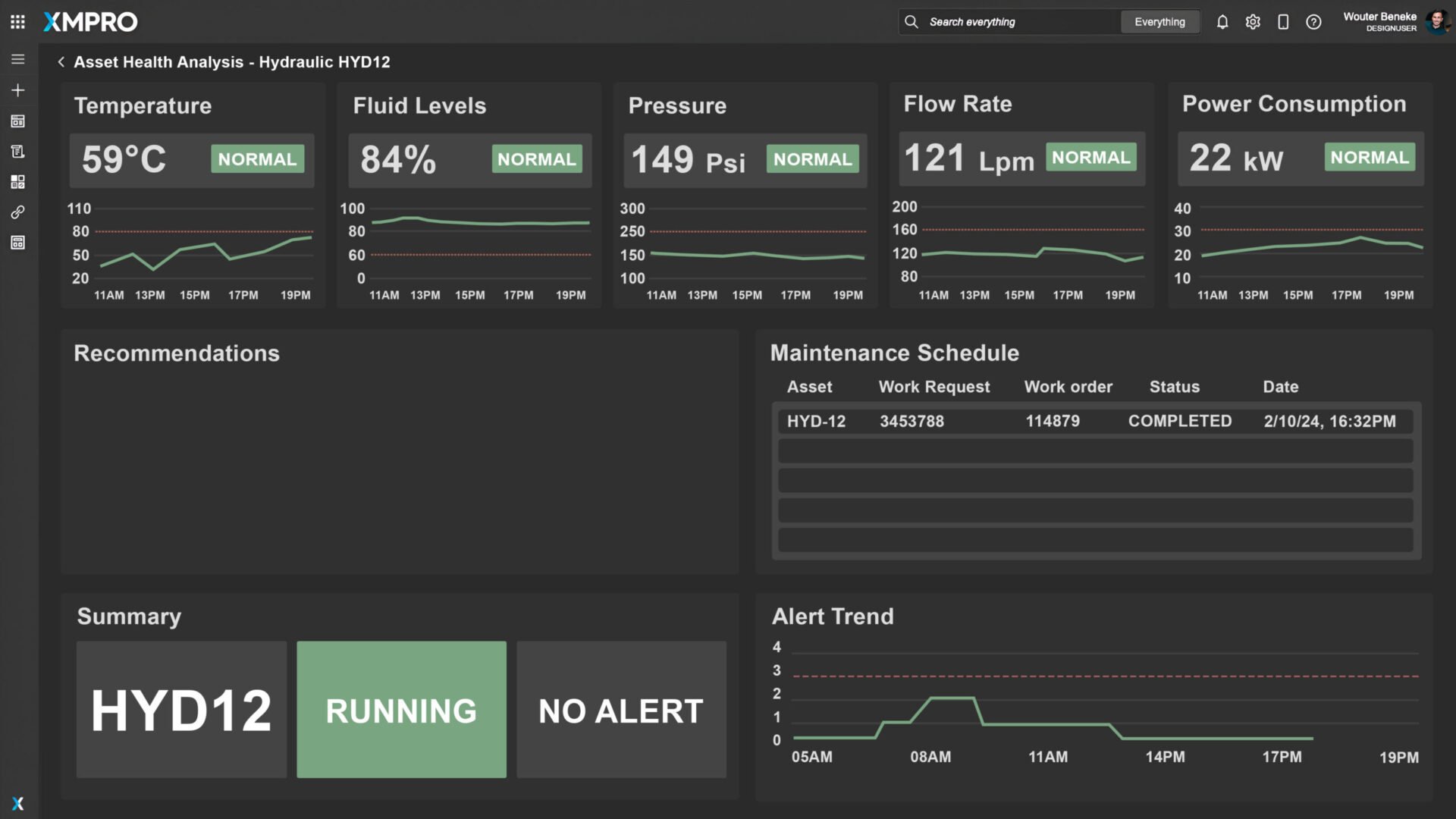
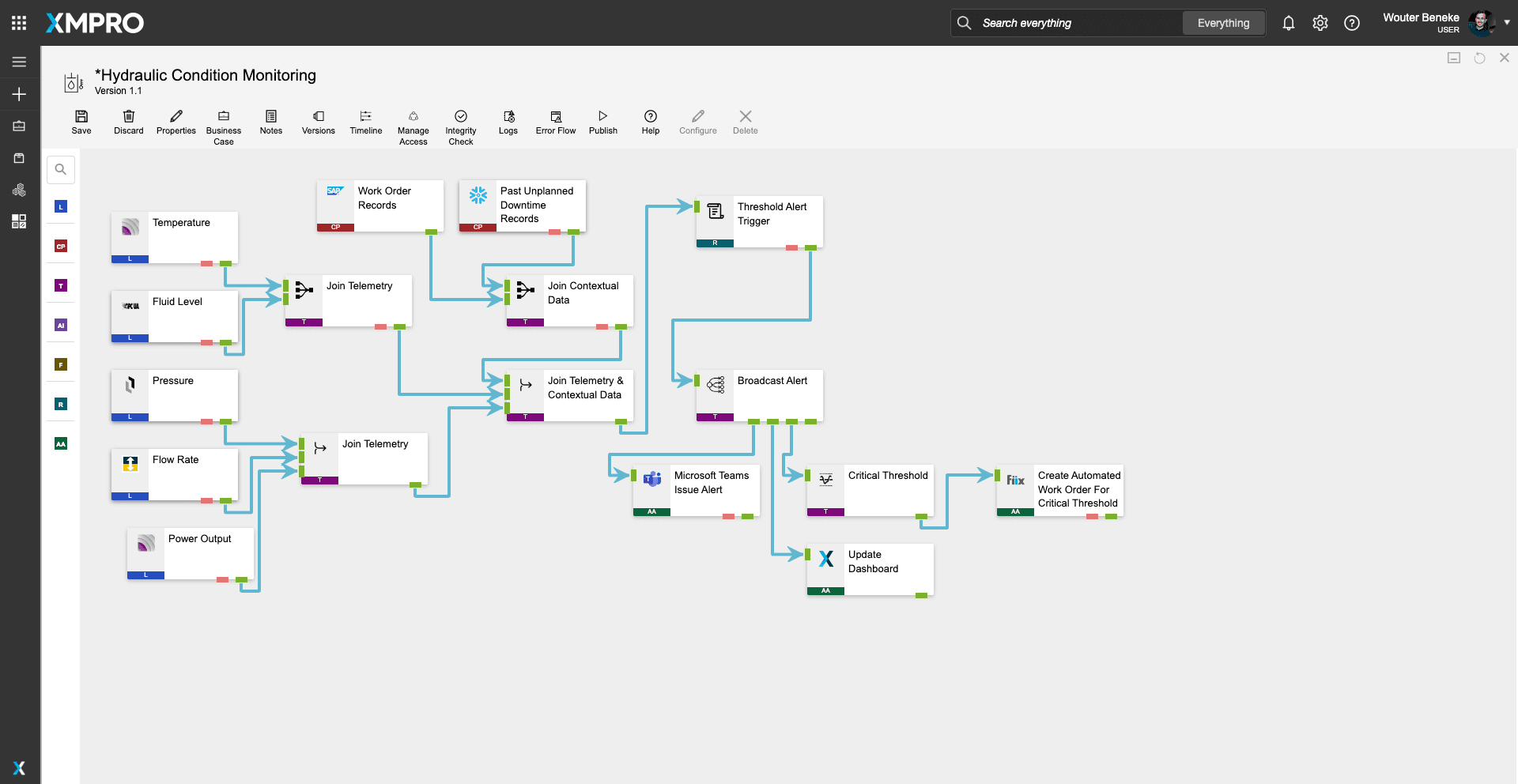
*Illustrative dashboards from the platform. Layout, signals and decision points are scoped per site.
Scope this for your operation.
Tell us about your fleet, your control maturity and the lever that matters most. We’ll map this use case to your starting point.
What this looks like in operation.
Predicted condition, planned maintenance
Failure modes surface ahead of the trip so production plans around interventions rather than reacting to them.
Right-sized service intervals
Work moves from OEM calendar to actual system condition, freeing crew time for higher-value reliability tasks.
Safer operating envelope
Systems running outside safe limits are flagged in real time, before the hazard becomes an incident.
Built for these industries.
Other solutions you might explore.
Not a concept. In production.
XMPro is deployed at Tier 1 global operators across asset-intensive and mission-critical industries — delivering measurable results across predictive maintenance, process optimisation and operational intelligence.
Now pushing the frontier.
MAGS agents are achieving what no other industrial platform has demonstrated — sustained autonomous operations at enterprise scale.