
Condition Monitoring · OIL & GAS
Bring wells back to production on a managed signal, not a guess.
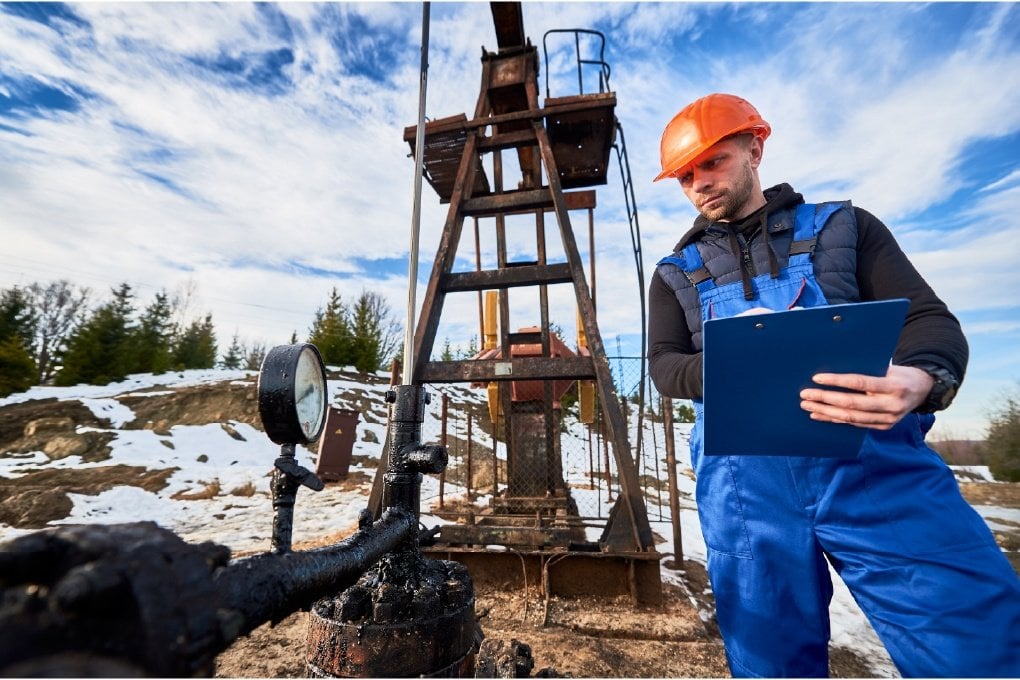
Returning a non-operational or underperforming well to production sits at the intersection of speed, equipment health, environmental compliance and cost. The XMPro AO Platform monitors the well, equipment and operating parameters in real time during the RTP process so restoration is managed against predicted condition and optimisation targets, not stopwatch pressure.
What's getting in the way today.
Return-to-production runs into five compounding pressures:
Restoration efficiency
Restoring non-operational or underperforming wells quickly and efficiently is complex — too fast and equipment health suffers; too slow and production stays off.
Predictive maintenance during RTP
Maintenance needs that surface during restoration can either be addressed pre-emptively or trigger another shutdown shortly after RTP completes.
Production optimisation
The well needs to return to optimal production capacity — not just any production — while equipment health is maintained.
Data integration and analysis
Sensor data, well performance and historical context have to combine into a decision-ready picture during RTP, not after it.
Environmental and safety compliance
RTP activity is one of the higher-exposure operations in the field — environmental and safety evidence has to be auditable, not reconstructed.
Oil Well RTP Monitoring — how it works.
A real-time picture of well and equipment during RTP — fed by IoT sensors, modelled as a digital twin, and tied to predictive analytics and parameter optimisation so the restoration runs on a managed signal.
The platform models the well and its associated systems as a digital twin, ingesting telemetry on production rate, equipment condition (pumps, valves, sensors) and operational parameters (pressure, temperature, flow). Predictive analytics flag maintenance needs that emerge during restoration before they trigger another shutdown. Operational data analysis optimises production parameters to maximise extraction efficiency while preserving equipment health. Real-time monitoring of KPIs and automated recommendations surface optimisation opportunities and risks. Customisable dashboards expose well state to operations and compliance teams; environmental and safety telemetry feeds compliance reporting directly.
*Illustrative dashboards from the platform. Layout, signals and decision points are scoped per site.
Scope this for your operation.
Tell us about your fleet, your control maturity and the lever that matters most. We’ll map this use case to your starting point.
What this looks like in operation.
Faster, safer restoration
RTP runs on predicted condition and ranked recommendations, so restoration time and equipment risk are balanced rather than traded.
Production back at optimal capacity
Operating parameters are tuned against well-level optimisation targets, not the last operator’s preference.
Compliance evidence as a by-product
Environmental and safety monitoring during RTP generates audit-ready evidence — defensible for regulator inspection.
Built for these industries.
Other solutions you might explore.
Not a concept. In production.
XMPro is deployed at Tier 1 global operators across asset-intensive and mission-critical industries — delivering measurable results across predictive maintenance, process optimisation and operational intelligence.
Now pushing the frontier.
MAGS agents are achieving what no other industrial platform has demonstrated — sustained autonomous operations at enterprise scale.