
The Value of a Composable Digital Twin
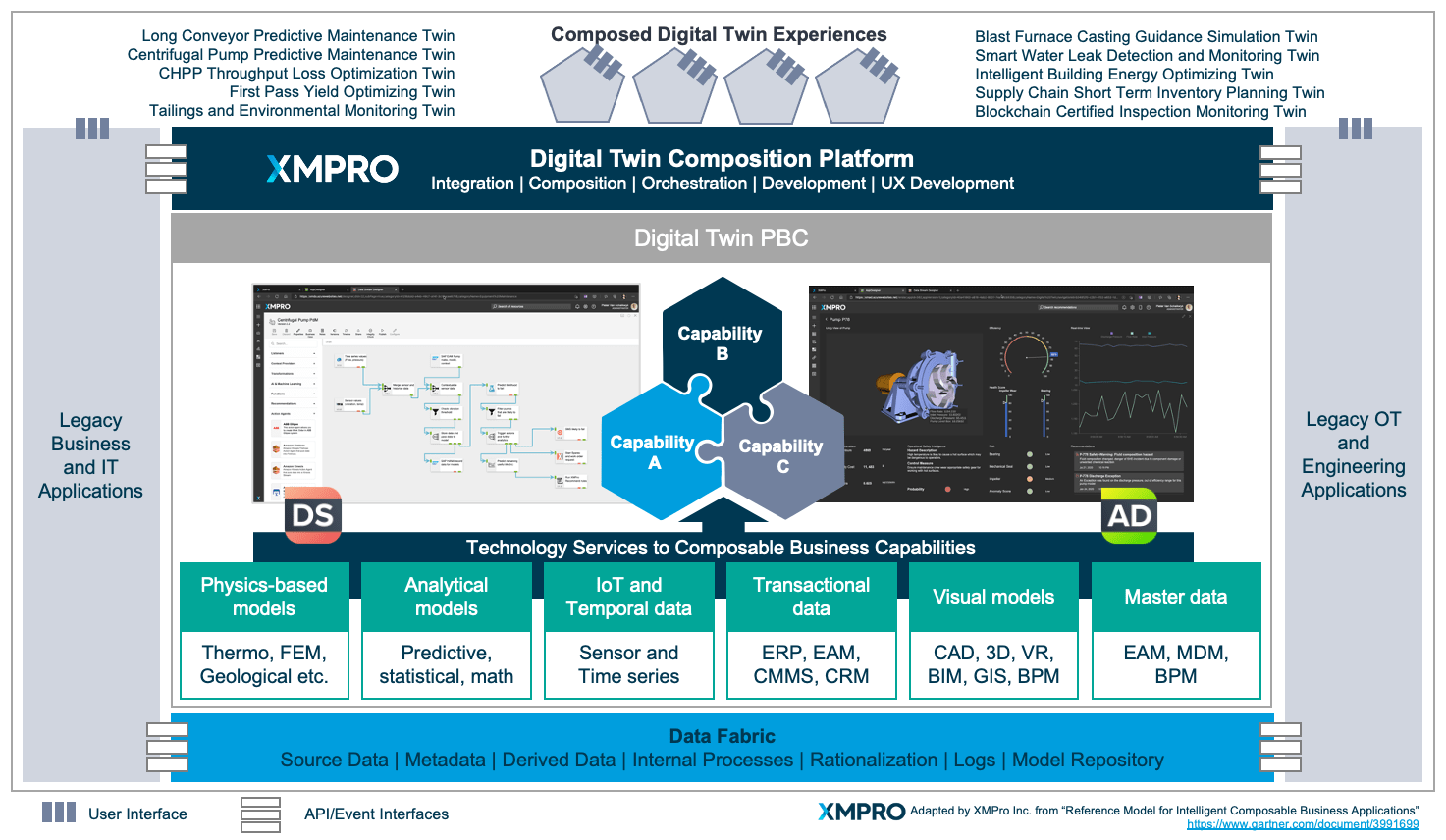
What is a Composable Digital Twin
2020 will go down in history as one of the most disruptive, uncertain, and transformative years for people and organizations worldwide. Or, as one of my learned friends explained, “overnight it exposed the systemic fragility in the operating capabilities of enterprises and organizations”.Many experts have commented on the unprecedented acceleration of digital technology adoption and the behavioral transformation in business that was activated during the pandemic. Five years of Digital Transformation happened in less than five months, according to industry analysts.
Some organizations were able to adjust quickly and exploit opportunities from the turmoil. In contrast, others are still paralyzed by rigid business systems and processes that are typical of traditional enterprise architecture approaches.
The future reality is that the rate of change will only increase. Professor Peter Frisk, who specializes in “innovative business future”, says that we will see more change in the next 10 years than in the last 250.
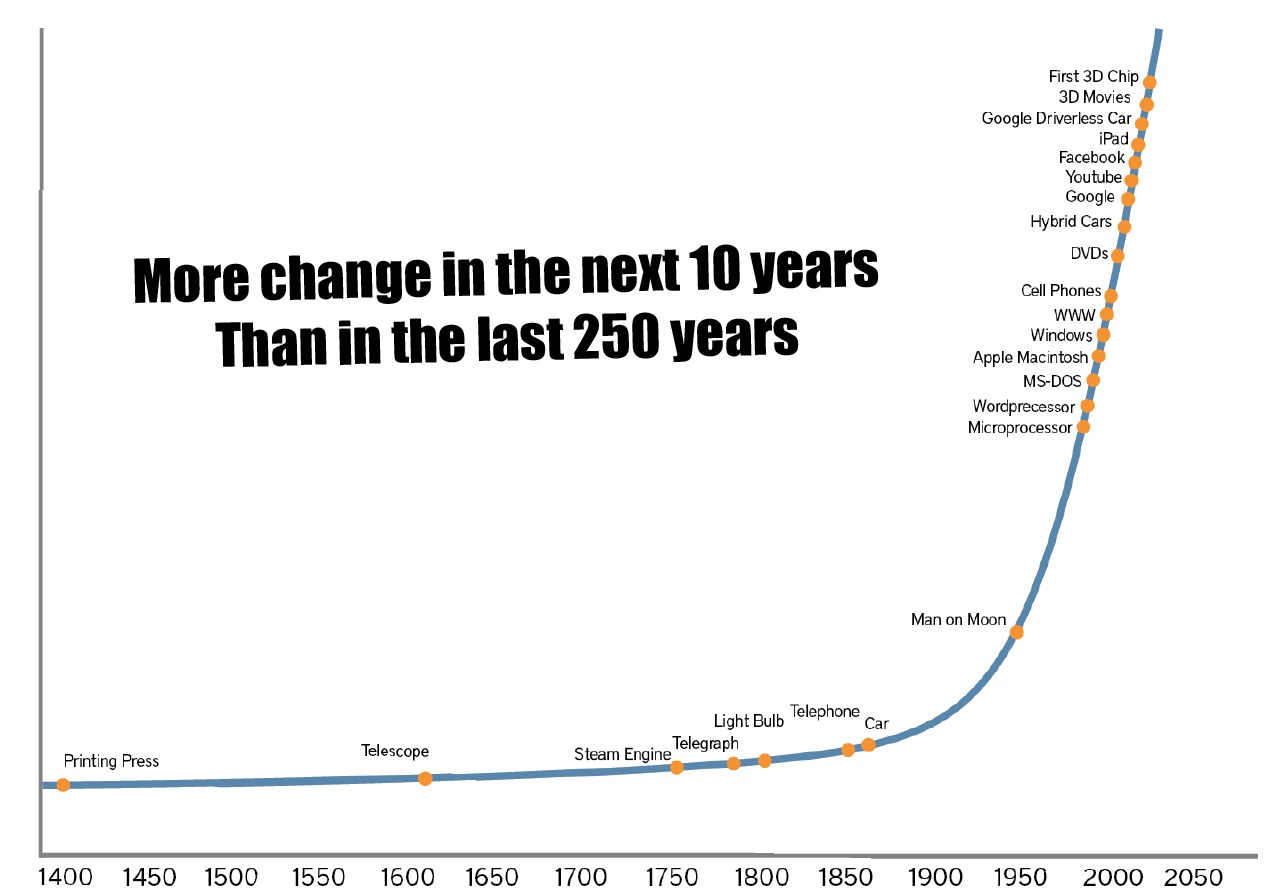
But the pace of business changed in correlation with the rate of change as Peter Frisk’s graph points out. The average lifespan of companies has fallen from 75 years in 1950 to 15 years today; 52% of the Fortune 500 in 2000 were gone by 2020. The traditional enterprise has not kept up with the demands of fast-paced emerging technologies like Digital Twins, Internet of Things (IoT), Distributed Ledgers, AI, Quantum Computing, and a smorgasbord of high-impact technologies. These innovative technologies drive changes in new products, services and the new business models needed to support them.
The pace of change requires agile and resilient enterprise architectures that enable multi-disciplinary teams to be highly responsive in exploiting business events in an innovative way. It still, however, needs to have guardrails to protect the organization from unnecessary risk.
The keynote at Gartner’s 2020 ITxpo introduced the concept of a Composable Enterprise that enable teams that combine business and IT to compose new “fit for purpose” applications in a fraction of the time that it takes in traditional software development processes. Gartner predicts that “by 2023, organizations that have adopted an intelligent composable approach will outpace the competition by 80% in the speed of new feature implementation.” [1]
The Composable Enterprise is powered by Composable Business Applications. Digital Twins, in turn, are a class of this Composable Business Applications that deliver specific high-value business capabilities in the Composable Enterprise. Digital Twins can compose and package these high-value capabilities in what Gartner refers to as PBCs or Packaged Business Capability.
To better understand Composable Digital Twins (CDT) and their value to the organization, it is worth exploring Composable Business Applications in more detail.
What is a Composable Business Application?
Traditional 3-tiered business applications were hierarchically structured with a data layer at the base, an application logic layer in the middle, and a user interface layer at the top. The introduction of service-oriented architecture (SOA), APIs and micro-services provided some flexibility, but traditional business applications still reflect this rigid design pattern. Changes to business logic are compiled into the larger codebase of the application and rely on specialized developers to make changes at any of the three layers of the business application.The reference model describes the key components necessary to create Composable Business Applications for your Composable Enterprise. I highly recommend that you read the reference model document by Gartner, but I will highlight a few elements related to composing digital twins using this approach.
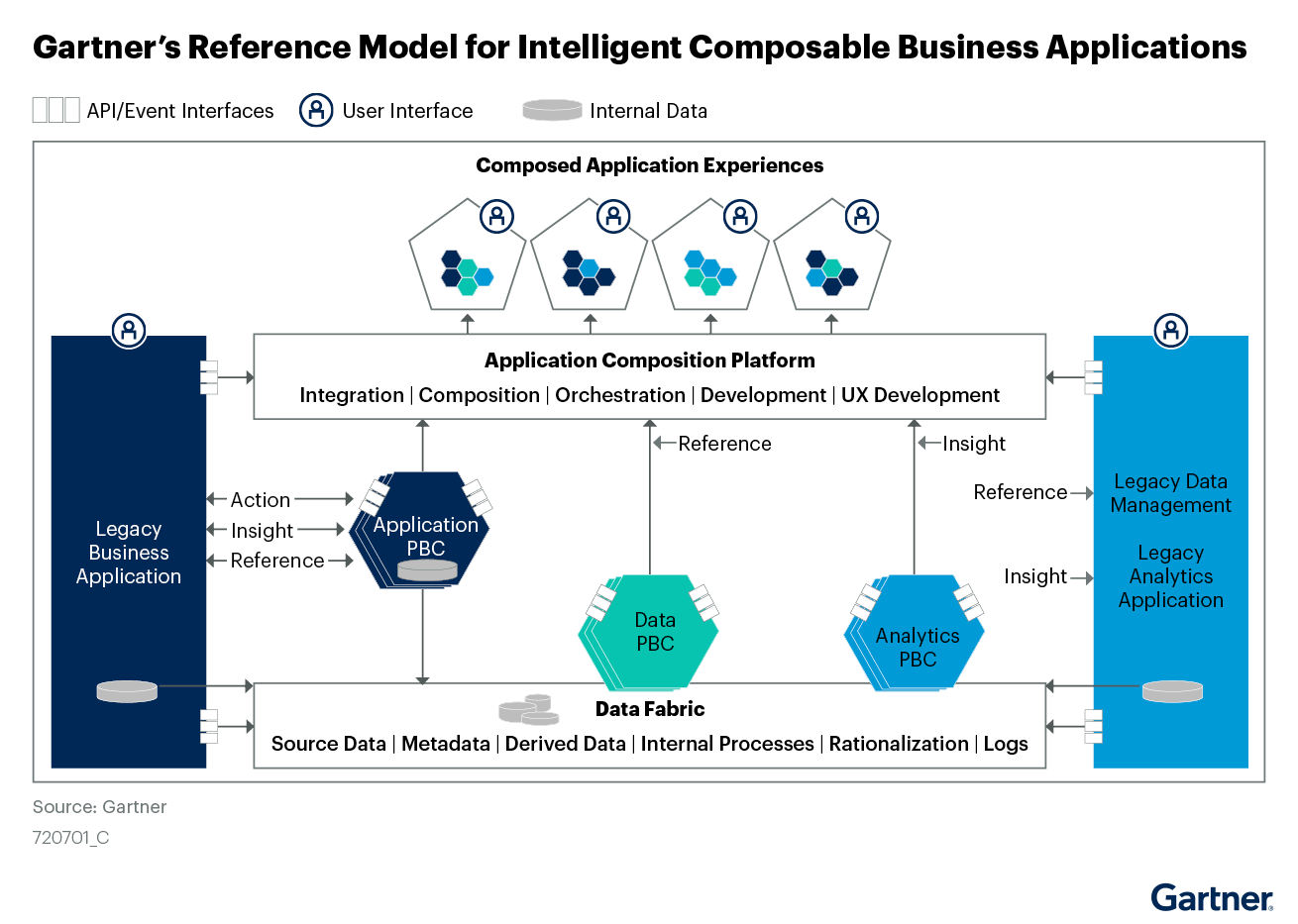
Reference Model for Intelligent Composable Business Applications (https://www.gartner.com/document/3991699)
Composable Business Applications use Application, Data, and Analytics PBCs through a Low Code Application Composition Platform to integrate, compose, orchestrate and provide a tailored user experience that focus on the critical business outcomes for the application. Applications can be composed and recomposed quickly by subject matter experts. This provides a high level of agility and flexibility to address new business challenges. A reliability engineer can, for example, create a predictive maintenance solution around a key asset that is suddenly impacting production capability due to a change in operating conditions or supply chain intelligence. The solution can be composed in a matter of days, in stark contrast to the traditional model that may take months or even years to deploy a solution like this.
PBCs enable the engineer to use sophisticated business capabilities without being an expert in data integration, predictive analytics, or digital twins. These capabilities are pre-packaged and available in a low code environment to drag-and-drop onto an application experience canvas. PBCs wrap integration, business logic, and analytical capabilities into reusable elements.
It’s like Lego bricks that kids use to build (compose) creations that are only limited by their imagination. The range of modular bricks enable the kids to, for example, create motion experience through packaged wheels, electric motors, gears and a range of other capabilities that take a few seconds to assemble. They have the option to follow the vendor’s assembly plans and build it as shown on the outside of the box. Alternatively, they only use elements of the original design and create their own unique instance that they can play with for a while before reconfiguring it into a new creation.
PBCs provide similar building blocks for the Composable Enterprise and bring built-in resilience, scalability and expertise.

Reference Model for Intelligent Composable Business Applications (https://www.gartner.com/document/3991699)
Gartner describes PBCs in the reference framework as follows:
PBCs are encapsulated software components that represent a well-defined business capability, recognizable as such by a business user. Well-designed PBCs are:
- Modular: Partitioned into a cohesive set of components.
- Autonomous: Self-sufficient and with minimal dependencies to ensure flexibility in composition.
- Orchestrated: Packaged for composition to assemble process flows or complex transactions through APIs, event interfaces or other technical means.
- Discoverable: Designed with semantic clarity and economy to be accessible to business and technical designers, developers, and active applications.

The Composable Digital Twin Business Capability
Now that we know what a Composable Business Application is, we can turn our attention to Composable Digital Twins. We mentioned above that it is an application-based “Packaged Business Capability”. Digital Twin PBCs are used to create unique application experiences to address target opportunities or challenges.In “Digital Twins: The Ultimate Guide” I describe the 6 types of data and models that we can combine in different configurations to provide the real-time intelligence and decision support that we to reusable compose Digital Twin capabilities.
The 6 data types and models are:
- Physics-based models (FEM, Thermodynamic, Geological)
- Analytical Models (Predictive Maintenance)
- Sensor and Time series data (IoT platforms and Historians)
- Transactional data (ERP, EAM)
- Visual Models (CAD, AR, VR, BPM, BIM, GIS, and GEO)
- Master Data (EAM, AF, BPM)
Examples of these Packaged Business Capabilities (PBC) for Digital Twins are:
- Time Series data ingestion, validation, anomaly detection and forecasting as an integration PBC
- Real-time data updates from time-series data sources to a gaming engine or 3D visualization model
- Integrating real-time sensor data and context data from a maintenance system to a Python scheduling and optimization algorithm
- Integrating real-time IoT sensor data with GIS technology to create track-and-trace with geofencing capabilities.
- the actions of people in your business
- the actions of your competitors, customers, legislators or suppliers
- external events such as pandemics and extreme weather
- equipment breakdown, process failures, environmental events
- the operational intelligence that you gather from your business applications, data sources and web services; and
- more recently, the influx of information from the Internet of Things (IoT) with sensor-based or smart device machine-born data (IoT Platforms).
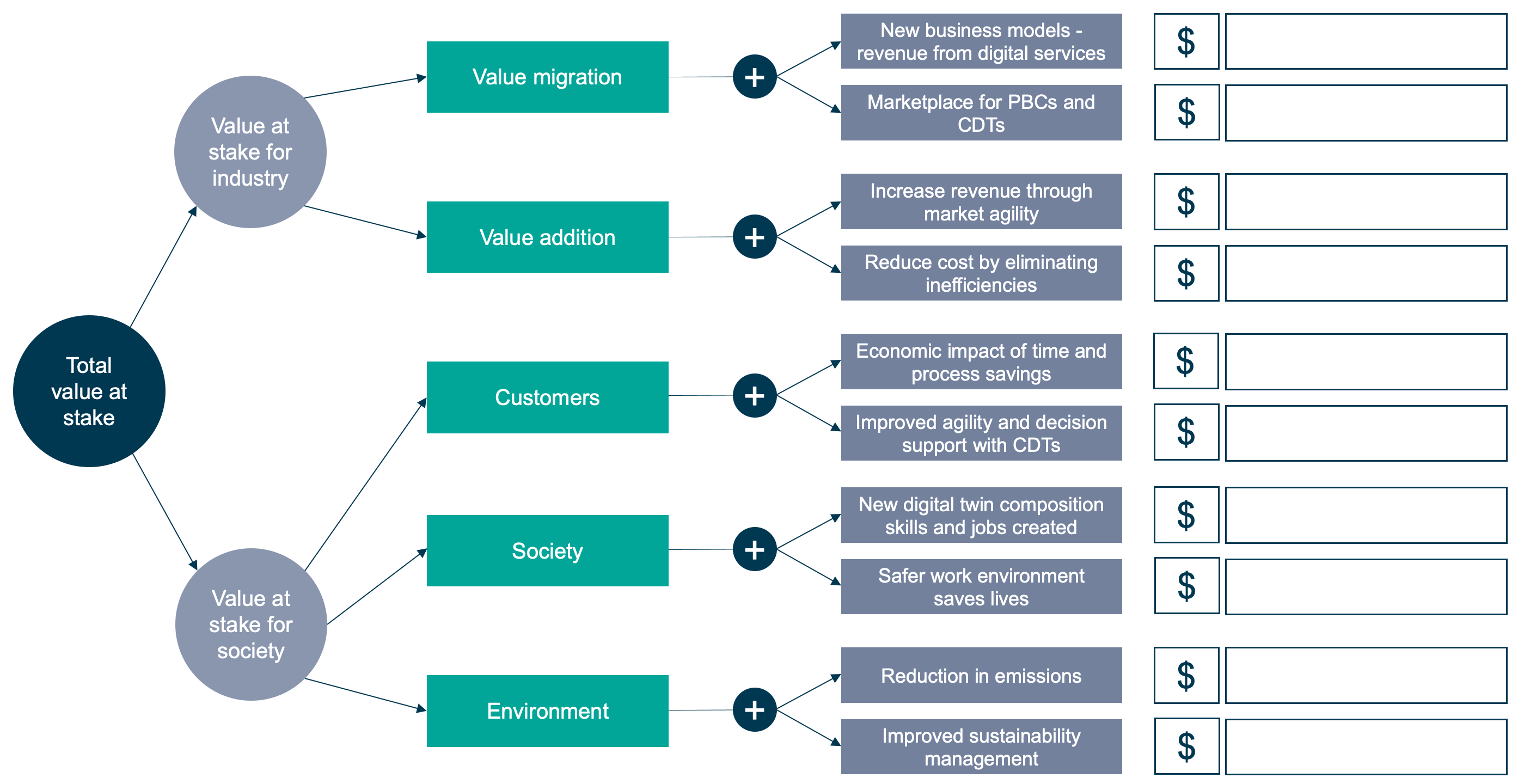
Typical Value at Stake calculation for Composite Digital Twins
The VaS model is based on the practical measurements and quantification of the following elements:
- The value of empowering your subject matter experts with low code composition tools to create their own CDTs without being an experienced developer
- They can address the business problems firsthand without being a technology expert, but leverage state-of-the-art capabilities when composing CDTs
- They can create new solutions in an iterative way, by composing and recomposing minimum viable Digital Twins until they have a problem/solution fit. See our 3-part series on the Lean Digital Twin
- Your subject matter experts can compose new Digital Twin capabilities in days, rather than weeks or months, to address opportunities and risks in a quick and timely manner
- A resilient composable architecture reduces the brittleness of traditional system and business application complexity, and the resulting cost of ownership
- It removes bloatware or features that you pay for, but don’t use in traditional business and OT applications
- It enables you to compose Digital Twins or your assets, processes, supply chains, or organization from the bottom up. You can compose Digital Twins based on business problems and aggregate the solution as you gain the benefits of each incremental step
- A marketplace of preassembled CDTs based on PBCs reduces the complexity of composing Digital Twins
- Custom CDT capabilities of modern composition platforms allow you to develop your own CDTs and PBCs that address the unique requirements of your use case
- Create your own library of reusable CDTs with your own organizational IP as a competitive advantage for capabilities that make your organization unique. Use generic CDTs for capabilities that provide no competitive advantage.

CDTs maximize the opportunities from “Easy Wins” vs the risk of the “Big Bets”.
XMPro Digital Twin Composition Platform
Creating Packaged Business Capabilities (PCB) like Composable Digital Twins (CDT) typically require a low-code Application Composition framework to deliver quick time to Value at Stake.XMPro’s Low Code solution provide the end-to-end capabilities for a Digital Twin Composition Platform. These capabilities include integration, composition, orchestration, development, and UX development in a single solution to create Digital Twin PBCs and more comprehensive Composed Digital Twin Experiences. XMPro manages the design and operation of Digital Twins across the lifecycle and can be compared to a composer who is also the conductor in an orchestra.
XMPro Digital Twin Composition Platform
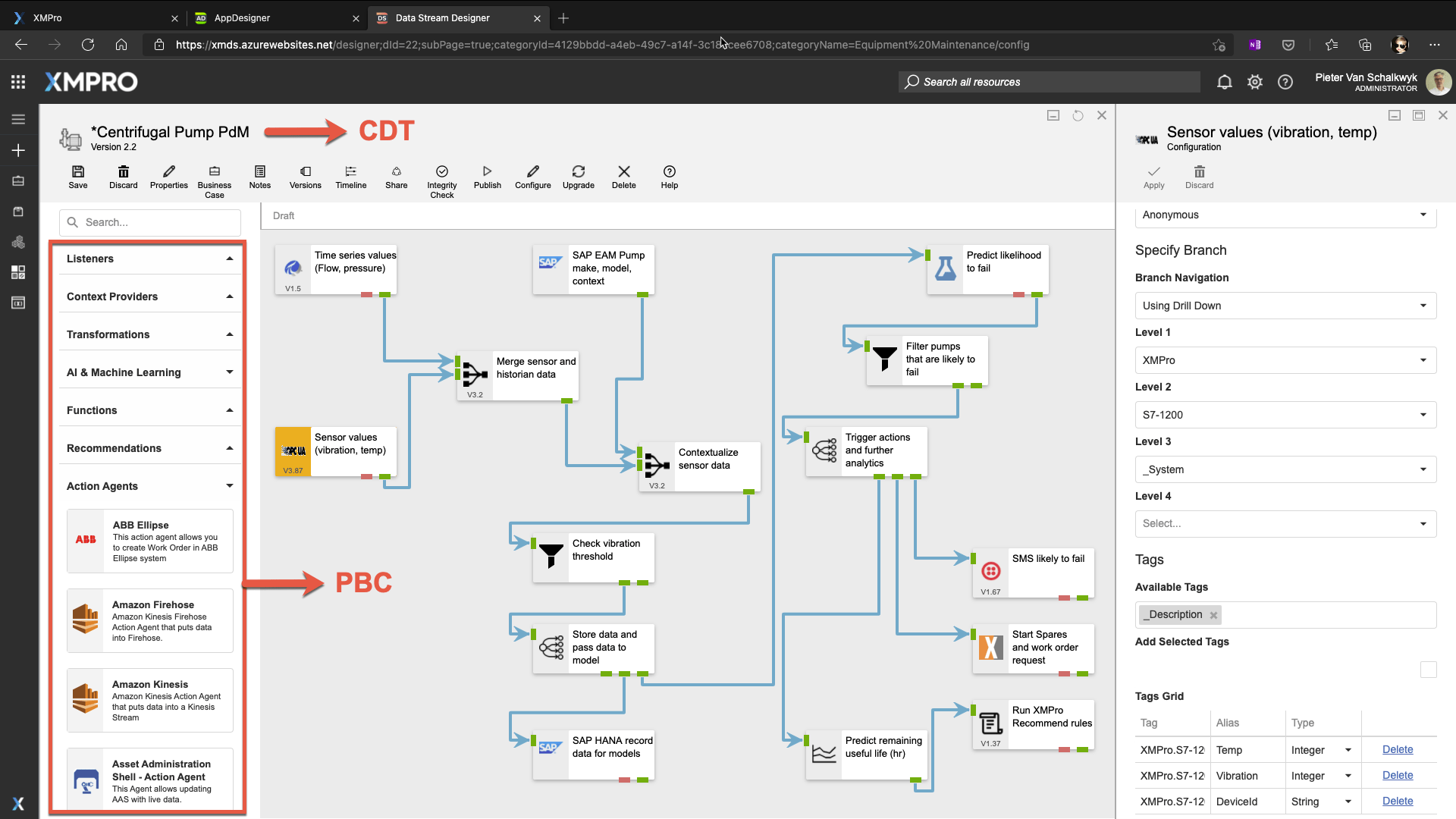
XMPro Data Streams Designer with Packaged Business Capabilities
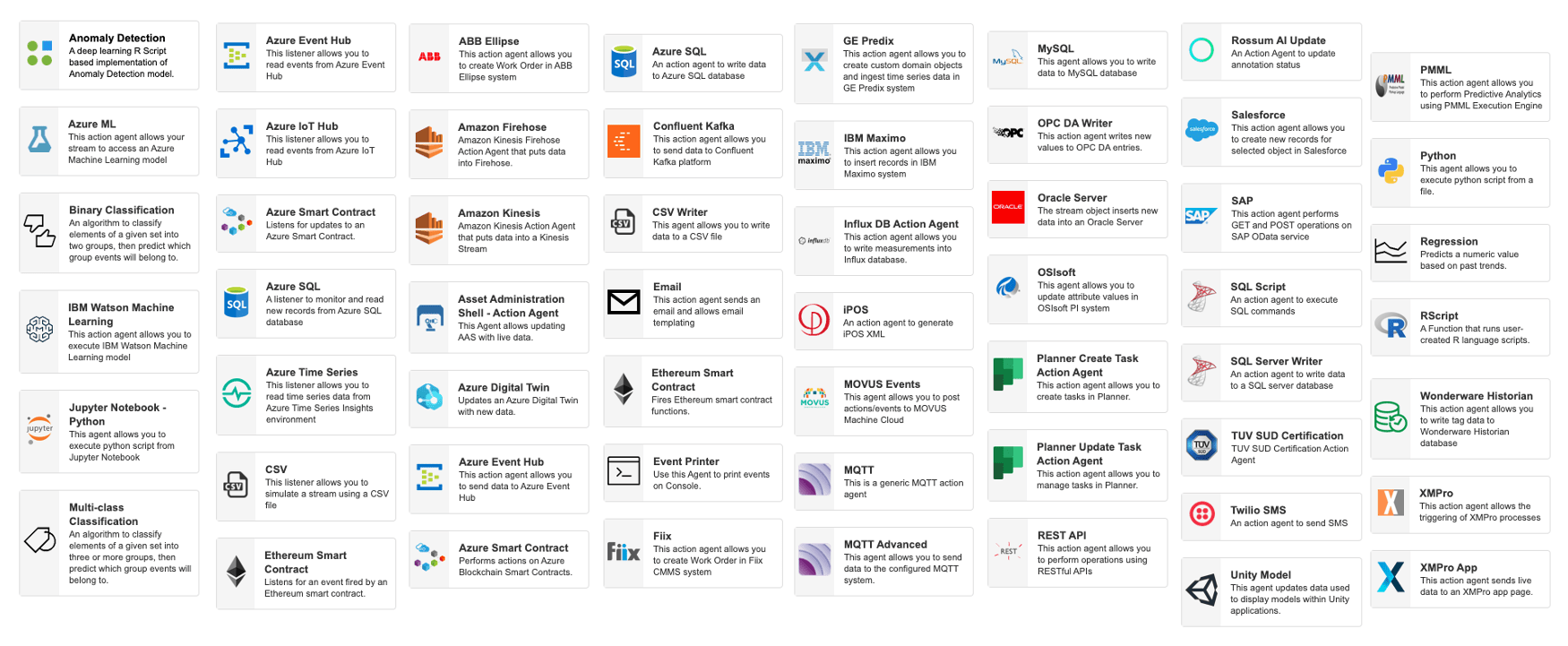
Examples of drag-and-drop Packaged Business Capabilities in XMPro DS
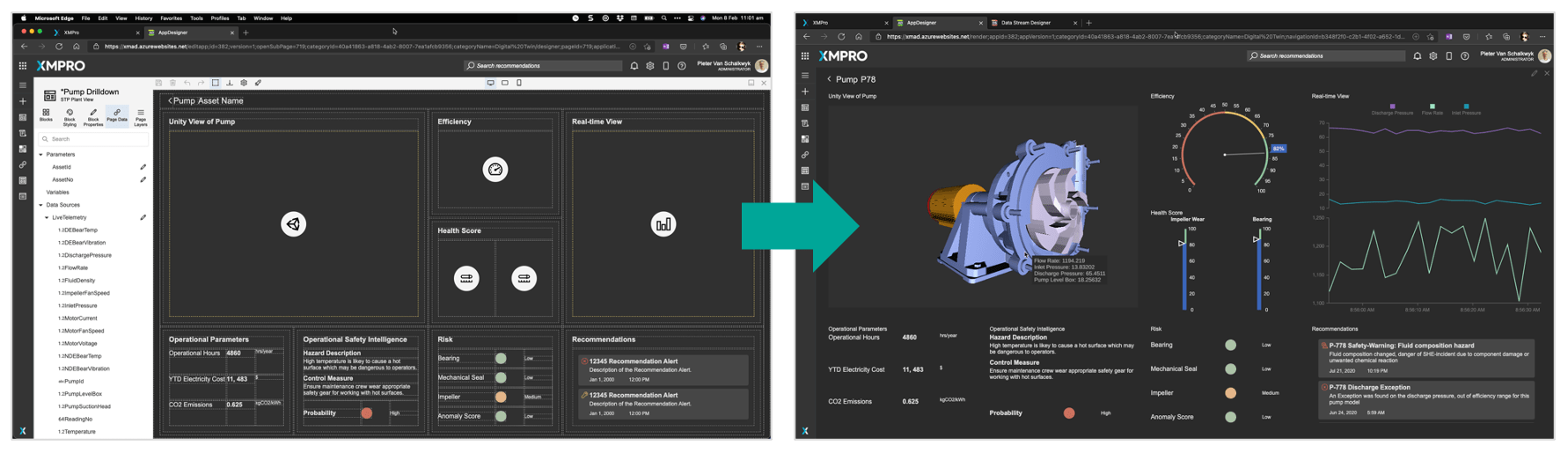
From drag-and-drop composition to production Digital Twins
XMPRO Recommendations in the App Designer, are advanced event alerts that combine alerts, actions, and monitoring. You compose recommendations based on business rules and AI logic to recommend the best next actions to take when a specific event happens. You can monitor the actions against the outcomes they create to continuously improve your decision-making.
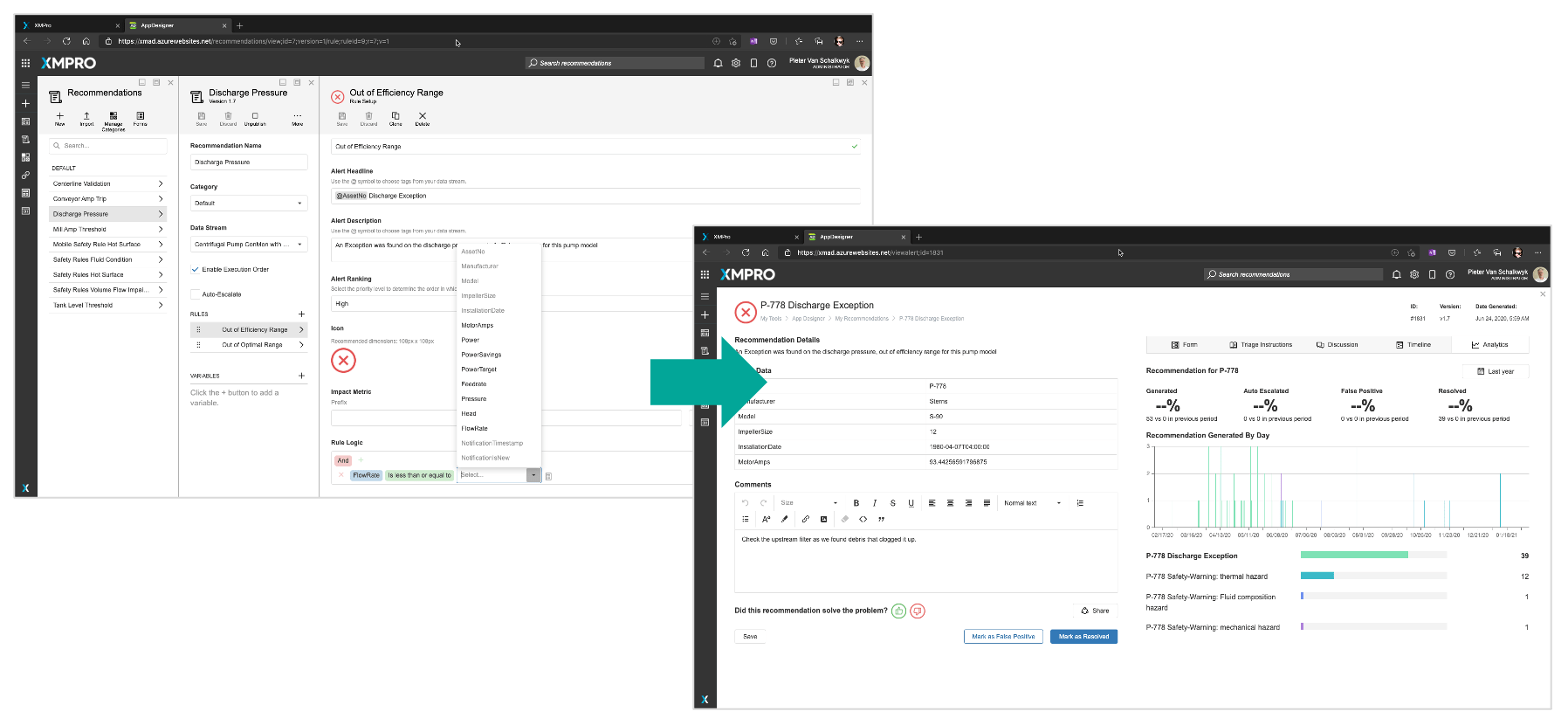
Composable recommendation rules from real-time event data
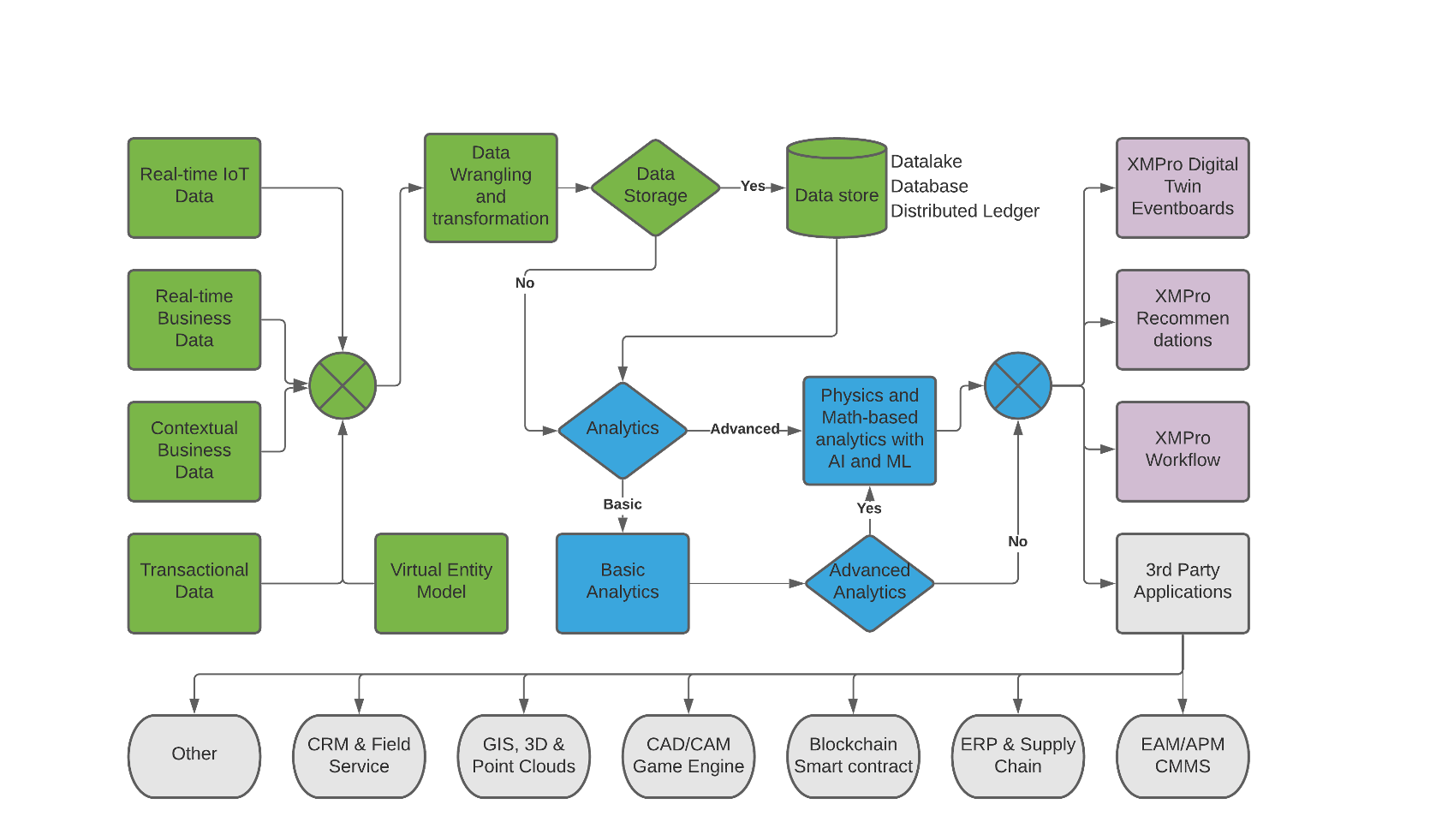
End-to-end Digital Twin development process in XMPro Digital Twin Composition Platform
- Gartner, Use Gartner’s Reference Model to Deliver Intelligent Composable Business Applications, Natis et al., 14 October 2020.
Gartner does not endorse any vendor, product or service depicted in its research publications, and does not advise technology users to select only those vendors with the highest ratings or other designation. Gartner research publications consist of the opinions of Gartner’s research organization and should not be construed as statements of fact. Gartner disclaims all warranties, expressed or implied, with respect to this research, including any warranties of merchantability or fitness for a particular purpose.