

Predictive Maintenance · MINING
Haul truck downtime is a production tax — predict it, schedule it, eliminate it.
Mining haul trucks operate against abrasive material, heavy loads and extreme environments — and a single unplanned breakdown reverberates through pit-to-port economics. The XMPro AO Platform fuses engine, hydraulic, drivetrain and tyre telemetry into a continuous picture of fleet condition, ranked by predicted failure and synchronised with the maintenance plan.
What's getting in the way today.
Haul truck reliability is the largest swing variable in pit economics. Four pressures compound:
Harsh duty cycle
Abrasive material, heavy loads, vibration and extreme temperature accelerate degradation across engine, drivetrain, hydraulics and tyres.
Mixed-fleet age and OEM
Trucks from different OEMs at different lifecycle stages need different maintenance triggers — standardisation by calendar misses both directions.
Remote sites, scarce crews
Maintenance resources at remote mines are finite, so misallocated crew time has an outsized cost on availability.
Telemetry overload
Each truck generates hundreds of operational signals; without ranking and context, the data hides the failure modes rather than surfacing them.
Haul Truck Predictive Maintenance — how it works.
A unified condition picture of every haul truck — engine, drivetrain, hydraulics, tyres and operational performance — fed by the sensors and OEM systems already in service, ranked by predicted failure and tied directly to maintenance scheduling.
The platform integrates haul-truck telemetry — engine health, payload weight, power output, fuel consumption, tyre pressure, hydraulic fluid quality, vibration and OEM error codes — continuously across the fleet. ML models analyse this telemetry to predict engine, drivetrain and hydraulic failures with confidence scoring and time-to-action windows. A digital twin lets reliability engineers simulate operating scenarios and tune intervention timing. Threshold breaches trigger ranked maintenance recommendations with severity, parts and crew assignment attached, with work-order creation feeding directly into the CMMS. Operators see live fleet geo-location and health with drill-down into individual trucks and recent recommendations.
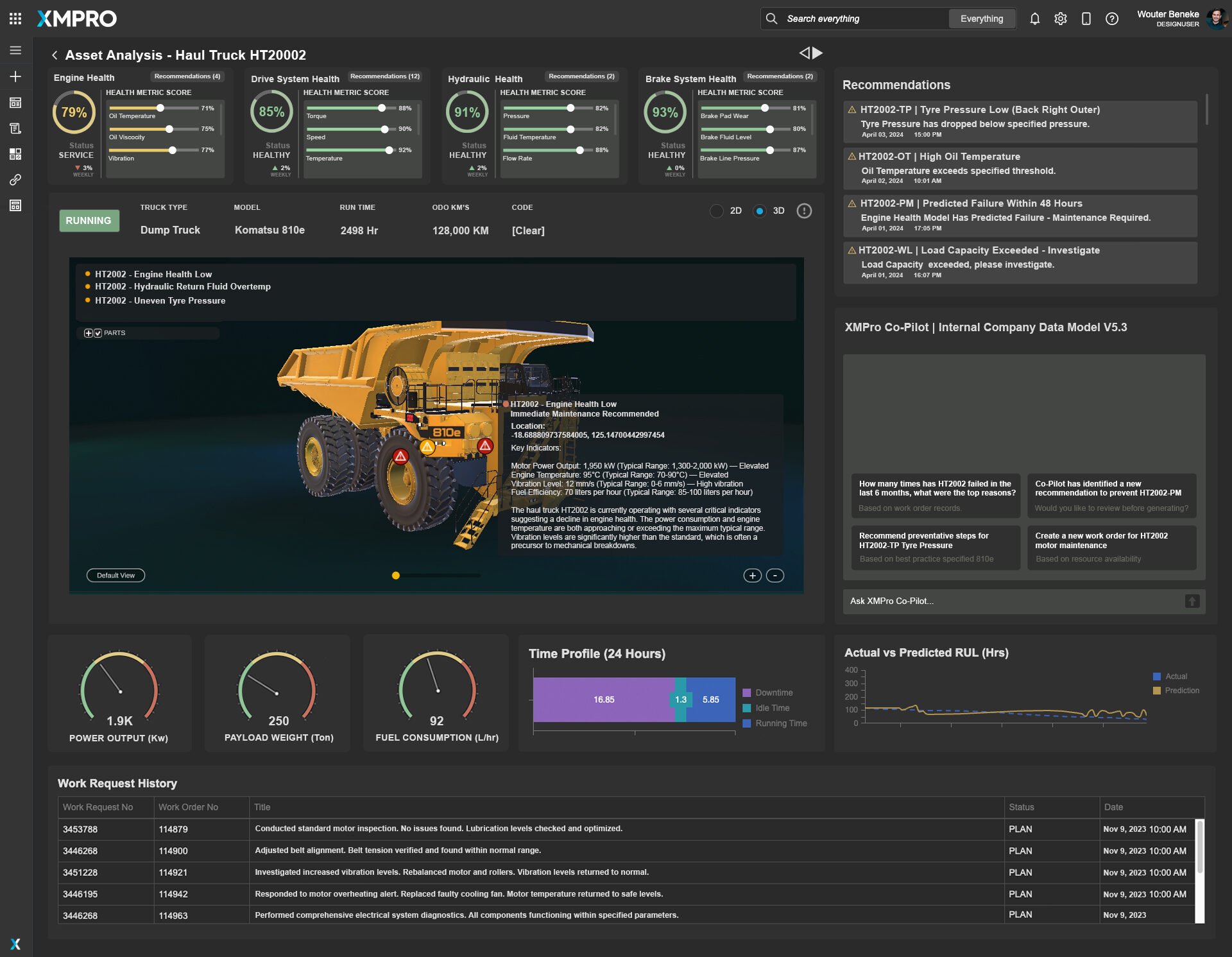

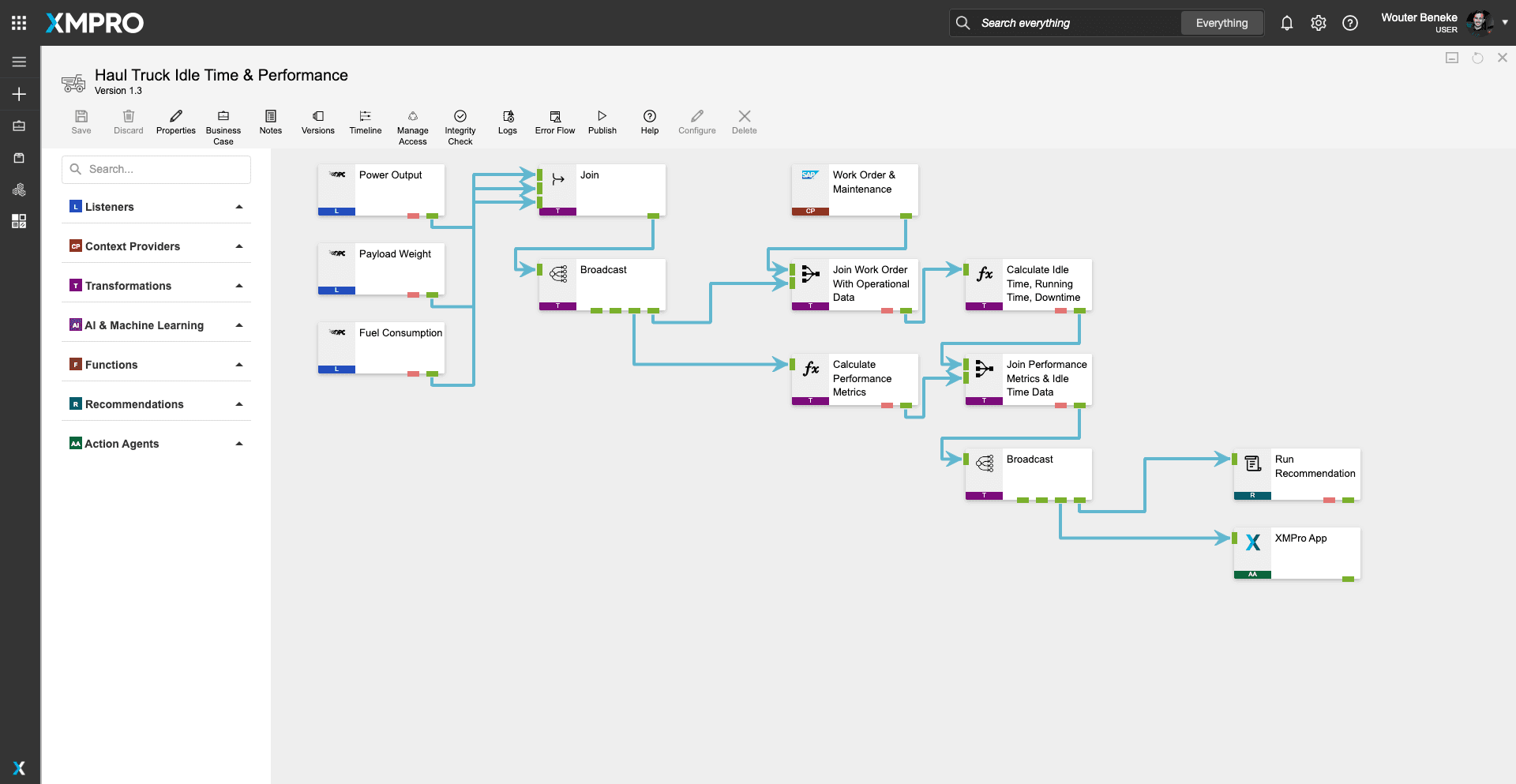
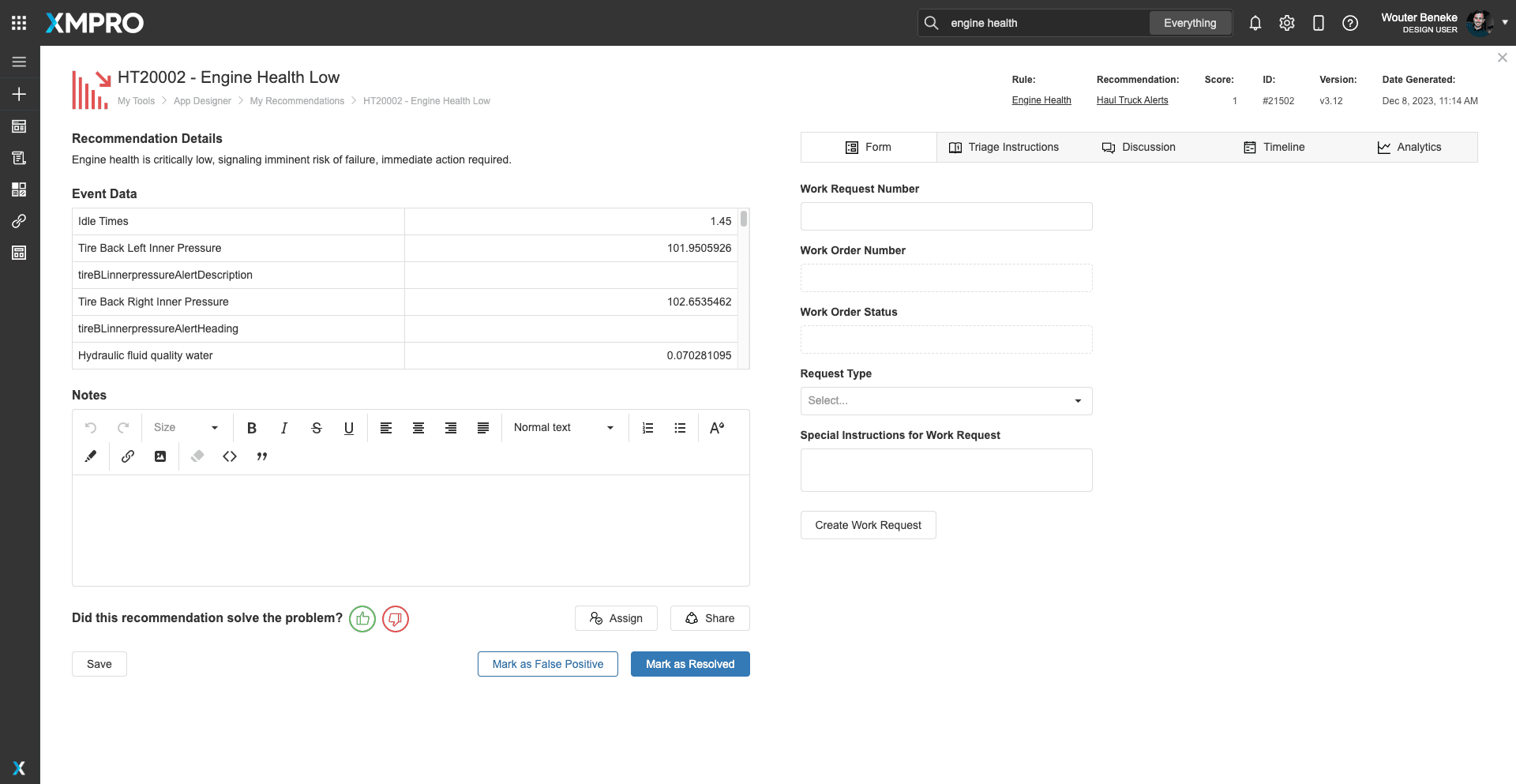
*Illustrative dashboards from the platform. Layout, signals and decision points are scoped per site.
Scope this for your operation.
Tell us about your fleet, your control maturity and the lever that matters most. We’ll map this use case to your starting point.
What this looks like in operation.
Predictable availability
Failure modes surface days ahead so production plans around interventions rather than reacting to them mid-shift.
Crew time spent on real work
Maintenance moves from OEM-calendar inspections to ranked condition-based interventions, freeing scarce remote-site crews for higher-value tasks.
Lower per-tonne maintenance cost
Right-sized maintenance against the duty cycle the truck actually runs — not the spec-sheet duty cycle — drives down maintenance-per-tonne over time.
Built for these industries.
Other solutions you might explore.
Not a concept. In production.
XMPro is deployed at Tier 1 global operators across asset-intensive and mission-critical industries — delivering measurable results across predictive maintenance, process optimisation and operational intelligence.
Now pushing the frontier.
MAGS agents are achieving what no other industrial platform has demonstrated — sustained autonomous operations at enterprise scale.