
Industrial AI doesn't have an artifact problem. It has a memory problem.
Most industrial AI buyers are about to inherit an artifact pile they cannot use. They will have agents that produce decent advisories, infrastructure that stores the files reliably, and a corpus they cannot query. The architecture decision that causes this is being made right now, in pilots, by people who do not know they are making it.
Here is what is happening underneath.
A category of infrastructure and supporting startups are appearing this year for AI agents: POSIX-compatible filesystems with built-in version control, designed specifically for agent workloads. Branches so agents work in parallel. Durable storage that survives sandbox death. Sparse materialisation for big document sets. Fine-grained access control. Full history.
It is real engineering on a real problem. Most agent runtimes today write artifacts to sandboxes that die in 30 minutes, or to S3 buckets where concurrent writes clobber each other, or to Git repositories that were never built for agent-scale traffic. For agents in horizontal contexts, a versioned filesystem with branching closes the gap.
For agents in industrial contexts, it does not. The shape of the problem is different at industrial scale, and a better filesystem does not reach it.
This is the second article in a short series on what changes about agent architecture when the operating context is operational technology: refineries, grids, mines, pharmaceutical plants. The first article made the case at the definition layer. When the agent’s authorisation envelope is a markdown file rather than a typed parametric record, the runtime cannot enforce what a regulator can audit. Same medium breaking. Different symptom. At the definition layer, the failure is enforcement. At the artifact layer, the failure is memory.
The question your plant manager will ask in 2030
A refinery, four years from now. Two hundred agents in production. Each producing fifty to three hundred artifacts a week: advisory alarms, condition assessments, work-order recommendations, shift-handover summaries, root-cause analyses. Call it fifty thousand artifacts a week across the fleet, conservatively.
The plant manager walks into the control room and asks a question.
“Has any agent in the fleet seen this failure pattern before? Show me the prior incidents, what was advised, whether the operator acted, and what happened next.”
This is not an audit question. This is the question every reliability engineer asks every shift, every plant manager asks every week, every operations director asks every quarter. The single most operationally valuable question an industrial agent fleet can answer.
Two failure shapes are worth walking, and they are easy to confuse.
Take the filesystem case first, the default shape industrial AI is inheriting from horizontal tooling. Every one of those fifty thousand weekly artifacts is a file. To answer the question, you crawl the directory tree, parse each file, match across them, join to the operator-action log in a separate system, join again to the outcome system, aggregate. Hours to days. The situation that prompted the question has moved on by the time you have the answer.
In a corpus-shaped architecture, you ask the question and get the answer in seconds. The artifacts are nodes in a graph, semantically embedded, time-stamped, joined to the operational data the agents were reading from. The question maps onto the architecture. The architecture answers.
That gap, between hours of forensic file-crawling and seconds of structured query, is what separates a growing archive from a knowledge asset. Fifty thousand artifacts a week is either a graveyard of one-off documents that gets harder to use, or institutional memory that gets more valuable each week. The deciding factor is whether the corpus is queryable, not how durably the files are stored.
Six capabilities, one architecture
Audit reconstruction is one capability of a queryable corpus. There are five others, and most of them matter more to the people writing the cheques.
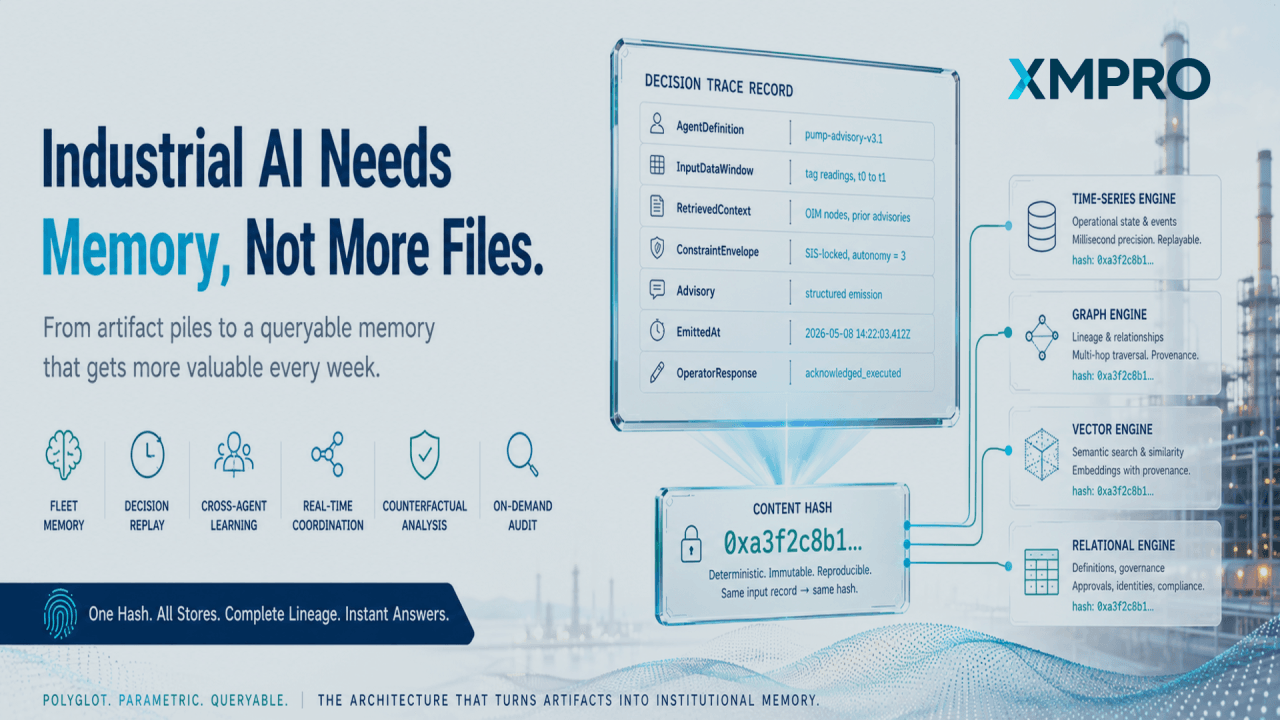
Fleet memory. Agent on Asset A sees a condition similar to one another agent saw on Asset C six months ago. The corpus surfaces the prior advisory, the operator’s response, the outcome. Knowledge that today lives in your senior reliability engineer’s head becomes queryable across the fleet. New plants you commission five years from now inherit memory from plants you commissioned twenty years ago.
Decision replay. Agent definitions evolve. When you promote a definition from v3.0 to v3.1, you want to know what the previous month of advisories would have looked like under the new definition. Counterfactual replay against historical data is a routine query against a corpus, and an impossible one against a folder of files.
Cross-agent learning. Which advisory patterns correlated with successful operator interventions? Which got overridden? Each override tells you where the agent’s operating envelope needs to widen or narrow. Continuous improvement on the agent population is a corpus-wide query, not a per-agent code review.
Real-time coordination. Two agents on overlapping assets, one on the upstream separator, one on the downstream compressor, should know about each other’s advisories. A queryable corpus exposes the overlap as a join. A folder of files leaves it as a discovery exercise the human operator does not have time for.
Counterfactual analysis. Before promoting a new constraint envelope or a new model version, simulate it against the historical decision corpus. Did it produce different advisories? Better ones? Worse ones? In which situations? This is the kind of pre-deployment validation AI-governance teams need but cannot run today.
On-demand audit. When the regulator asks what happened at 02:14 on a specific Tuesday, you reconstruct the agent’s exact state in seconds: definition hash, input tags, retrieved context, advisory emitted, operator response. Compliance is the sixth capability, not the first. It falls out of the architecture that already serves the other five.
These are operations capabilities, not compliance capabilities. They are what an industrial AI buyer actually wants when they say “we want agents at scale.” The auditor’s questions become routine queries against the same corpus the operator is using.
What it takes structurally
Two structural commitments make this work. Neither is exotic. Both are absent from filesystem-shaped architectures.
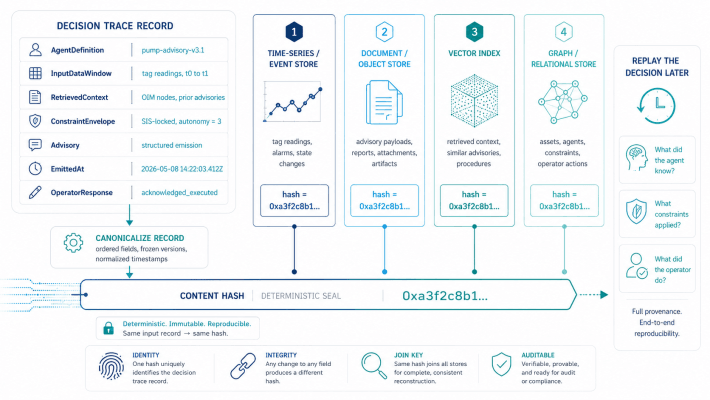
The first is parametric content hashing as the join key. Every artifact, every decision trace, every input data window, every agent definition has a deterministic content hash computed over its semantic structure. The hash is the identifier. Matching hash, matching content. Different hash, you know exactly which fields changed.
 Parametric Content Hashing
The hash is what makes joins across stores possible. The graph node, the vector embedding, the time-series annotation, the relational record all reference the same hash. The corpus stays consistent across storage engines. This is the same principle the first article made about definitions, applied to everything the agent produces.
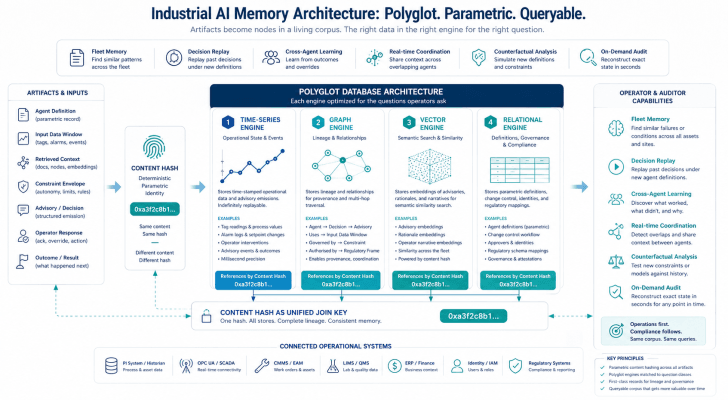
The second is a polyglot data architecture matched to the question classes the operator will ask. No single database engine answers all of them well. Forcing them onto one engine collapses one of the question classes. The natural composition is four engines.
A time-series engine stores the operational state the agent reasons over: tag readings, alarm logs, setpoint changes, operator interventions, the agent’s own advisory emissions. Millisecond precision, indefinitely replayable. This is what makes decision replay and counterfactual analysis possible. It is also where the existing OT estate plugs in: PI System, OPC UA bridges, historians.
A graph engine stores the lineage relationships. AgentDefinition produced DecisionThread consumed InputData under ConstraintEnvelope governed by RegulatoryFrame. Multi-hop traversal answers questions about provenance, fleet memory, and real-time coordination in milliseconds. The same traversal answers the auditor’s “trace this artifact back to its authorisation.”
Recommended by LinkedIn
A vector engine stores embeddings of past advisories, decision rationales, and operator narratives, each keyed by content hash so the embedding has provenance. Semantic similarity across the fleet, “what prior advisories are most like this one”, is a vector query. This is the engine that turns artifacts into a searchable institutional memory rather than a sequence of one-off documents.
A relational engine stores the parametric definitions, the change-control workflow records, the approver identities, the regulatory schema mappings. The joins compliance and governance teams need, “which definitions were approved by whom, with what scope, governing which agents”, are SQL’s natural shape.
 Polyglot Data Architecture
The four engines are not arbitrary. Each one corresponds to a class of question that an industrial operator will ask of an agent population. Take any one out and the corresponding capability becomes a forensic exercise.
Where database-backed frameworks stop short
This is the second failure shape, and it is easier to mistake for the answer than the first. The mature horizontal agent frameworks check point graph state to Postgres or SQLite. The market is past the filesystem default. Why is that not enough?
It gets you durability and resumption. It does not get you a queryable corpus.
Two hundred agents in a fleet means two hundred bespoke state schemas, each declared per-developer, none shared. Cross-agent query is JSONB-path forensics across mismatched shapes. The advisory the agent emits is whatever string the developer chose to return from the alarm tool. Definition identity, constraint envelope at decision time, retrieved-context hash, approver, lineage to the input data window: none of these are first-class fields in the stored record. Reconstructing any of them at audit or operations time still takes four systems and a willing developer.
“Use a database” is not the parametric thesis. Parametric content hashing across all stores, with shared join keys and first-class records for definition, input, constraint, advisory, and operator response, is what makes the corpus queryable. A folder of opaque JSON blobs in Postgres is a filesystem with extra steps.
The horizontal frameworks are not wrong. They are doing exactly what their buyer asked for: durable resumption of in-flight agent work in code. The buyer in industrial contexts is asking for something else.
The convergence
The pattern is the same at three layers.
At the definition layer, the file-based primitive fails because the runtime cannot enforce what is written in prose. The fix is parametric definitions: content-hashed, registry-tracked, schema-validated.
At the artifact layer, the file-based primitive fails because the corpus is not queryable. The fix is parametric artifacts: content-hashed, stored in a polyglot architecture matched to the question classes operators will ask.
At the decision layer, the same shift is coming. Decision traces stored as logs are no more queryable than artifacts stored as files. The bonded autonomy thesis depends on all three layers landing.
The new file-infrastructure products operating in this space do real engineering on the symptom one of these layers presents most visibly: file durability and concurrent-write conflicts. The structural argument is that the symptom is not the limit of the problem. At industrial scale, the corpus is the work product. The artifacts are nodes in it, not standalone deliverables.
Compliance follows capability, not the other way round
The architecture that lets you replay yesterday’s decisions, find related advisories across the fleet, run counterfactuals against new definitions, and coordinate agents in real time is, almost incidentally, the architecture that satisfies an auditor. Every artifact carries parametric content identity, lineage edges, semantic searchability, and time-stamped joins to operational state. The auditor’s questions become routine queries against the same corpus the operator is using.
The reverse architecture does not work. Build only for compliance, wrap a filesystem in attestation and lockfiles and signed bundles, and you produce a system that satisfies the regulator and constrains the operator. The corpus stays unqueryable. The capability stays out of reach. The audit is satisfied. The operations team is no better off.
The architectural choice has two paths: build for capability and inherit compliance, or build for compliance and constrain operations. The first path produces an industrial AI estate that gets more useful as it grows. The second produces one that gets harder to operate as it grows.
What to ask your team this quarter
Three questions worth taking to your AI lead, your platform vendor, or your OEM partner.
First. At fifty thousand artifacts a week per facility, can the operator ask “has any agent in the fleet seen this pattern before” and get an answer in seconds, or only in days? If the answer is “we have logs, the developer can write a query”, you are looking at a forensic exercise, not a corpus. Second. What is the join key across the agent’s definition, its decision trace, the input data window, and the retrieved context? If the answer is a run-id and a willing engineer, you have a four-systems reconstruction problem, not an architecture. Third. When the agent is promoted from v3.0 to v3.1, can you replay last month’s advisories under the new definition? If not, you do not have a corpus. You have a logfile.
These are the questions the architectural decision turns on. The architectural decision you sign in 2026 will run for fifteen to forty years. By 2030 the same deployments will involve hundreds of agents and tens of thousands of artifacts a week per facility. Whether that becomes a knowledge asset or a growing archive does not depend on how durably the artifacts are stored. It depends on whether the artifacts are nodes in a corpus the operator can query, or files in a directory the operator can only crawl.
The market is noticing the symptom. The structural answer is to build the memory architecture industrial AI actually needs, before the file-based default becomes the inheritance.
Pieter van Schalkwyk is the CEO of XMPro, specializing in industrial AI agent orchestration and governance. Drawing on 30+ years of experience in industrial automation, he helps organizations implement practical AI solutions that deliver measurable business outcomes while ensuring responsible AI deployment at scale.
He authored the Industrial AI Agent Manifesto, published by the Digital Twin Consortium in February 2026, a governance framework for trustworthy autonomous operations
Our GitHub Repo has more technical information. You can also contact myself or Gavin Green for more information.
Read more on MAGS at The Digital Engineer
Related: Bounded Is Not Bonded: What Berkshire’s AI Exclusion Means for Industrial Operators
This article originally appeared on XMPro CEO’s LinkedIn blog, The Digital Engineer, on 10 May 2026.