

Asset Utilisation Optimisation · MINING · IRON & STEEL
Iron-ore excavators that earn back the idle hours.
Excavators in iron-ore operations sit idle through bad scheduling, haul-truck waits and operator changeovers, while fuel use and throughput drift quietly hour by hour. The XMPro AO Platform brings idle time, cycle time, fuel and operator performance under one operational picture — with ranked recommendations the shift planner can act on the same shift.
What's getting in the way today.
Excavator productivity erodes across five reinforcing pressures:
High idle times
Prolonged inactivity from inefficient scheduling, operator breaks and waiting for haul trucks compounds across shifts — hidden in aggregates, expensive in dollars.
Fuel and emissions
Excavators consume large fuel volumes; inefficient operation drives cost and CO₂ simultaneously, with no visibility unless someone goes looking.
Throughput variability
Cycle time drifts with material type, equipment condition and operator efficiency, breaking production schedules without any obvious single cause.
Maintenance downtime
Unexpected breakdowns halt operations entirely; emergency repair cost and overtime erode the margin gained from running hot.
Operator performance variance
Skill differences across operators show up as wear, fuel and throughput — quiet drivers of cost that calendar-based programmes never address.
Excavator Efficiency Optimisation — how it works.
A continuous picture of every excavator — status, cycle time, fuel, emissions, operator performance — with recommendations that target the specific lever moving the wrong way.
The platform integrates IoT sensor telemetry continuously from each excavator — engine status, load capacity, vibration, fuel flow and operational mode — enriched with shift, zone and ore-grade context. Status timelines categorise the last 24 hours into running, idle, maintenance, refuelling, travelling, unplanned downtime and shift changes. ML models surface degradation patterns ahead of failure, while operational analytics expose the lever behind under-performance — haul-truck coordination, cycle bottlenecks, fuel-efficiency drift or operator variance — with ranked recommendations to the planner and dashboard alerts when cost-per-tonne, throughput or emissions breach configured bands.
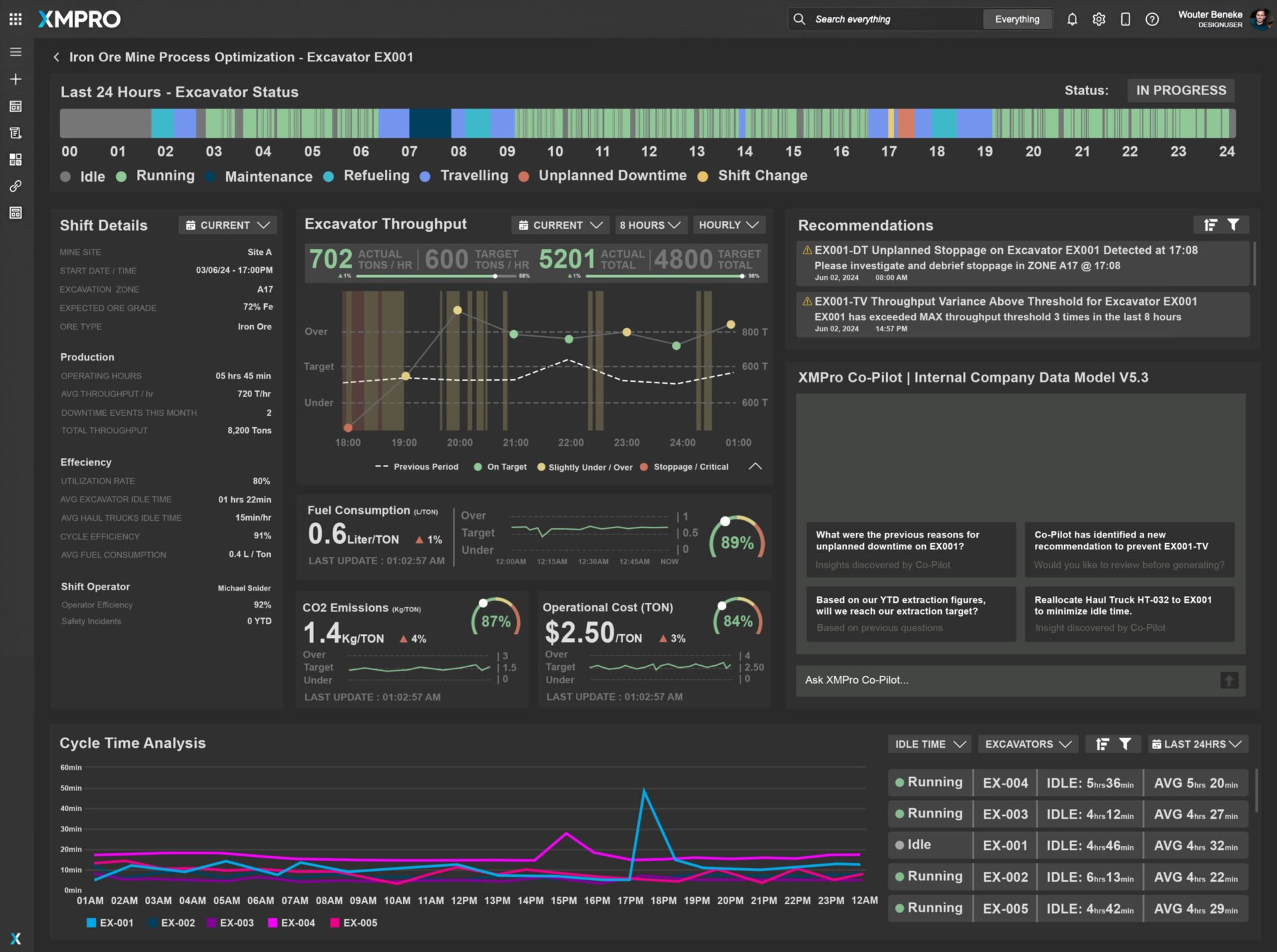
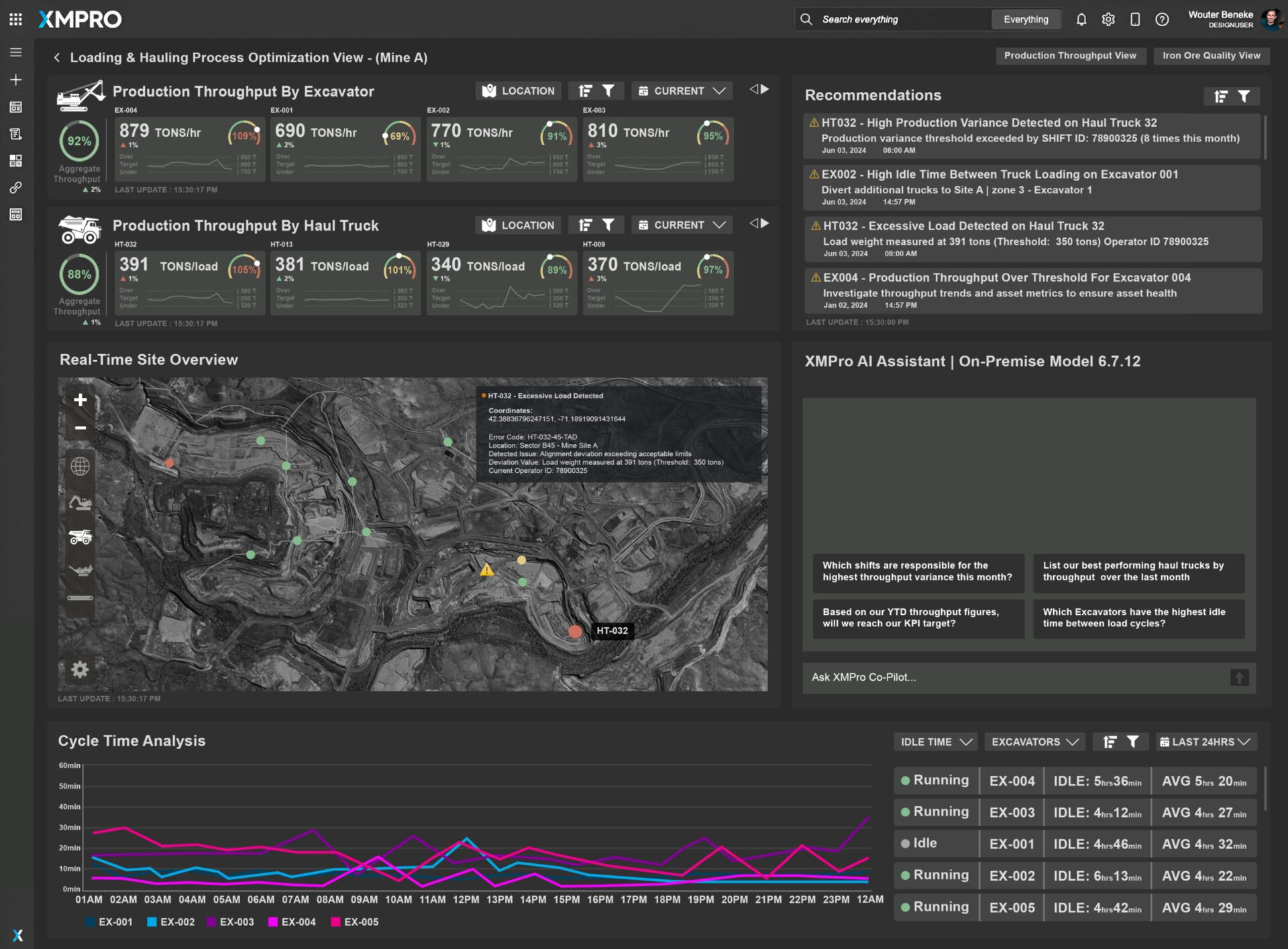
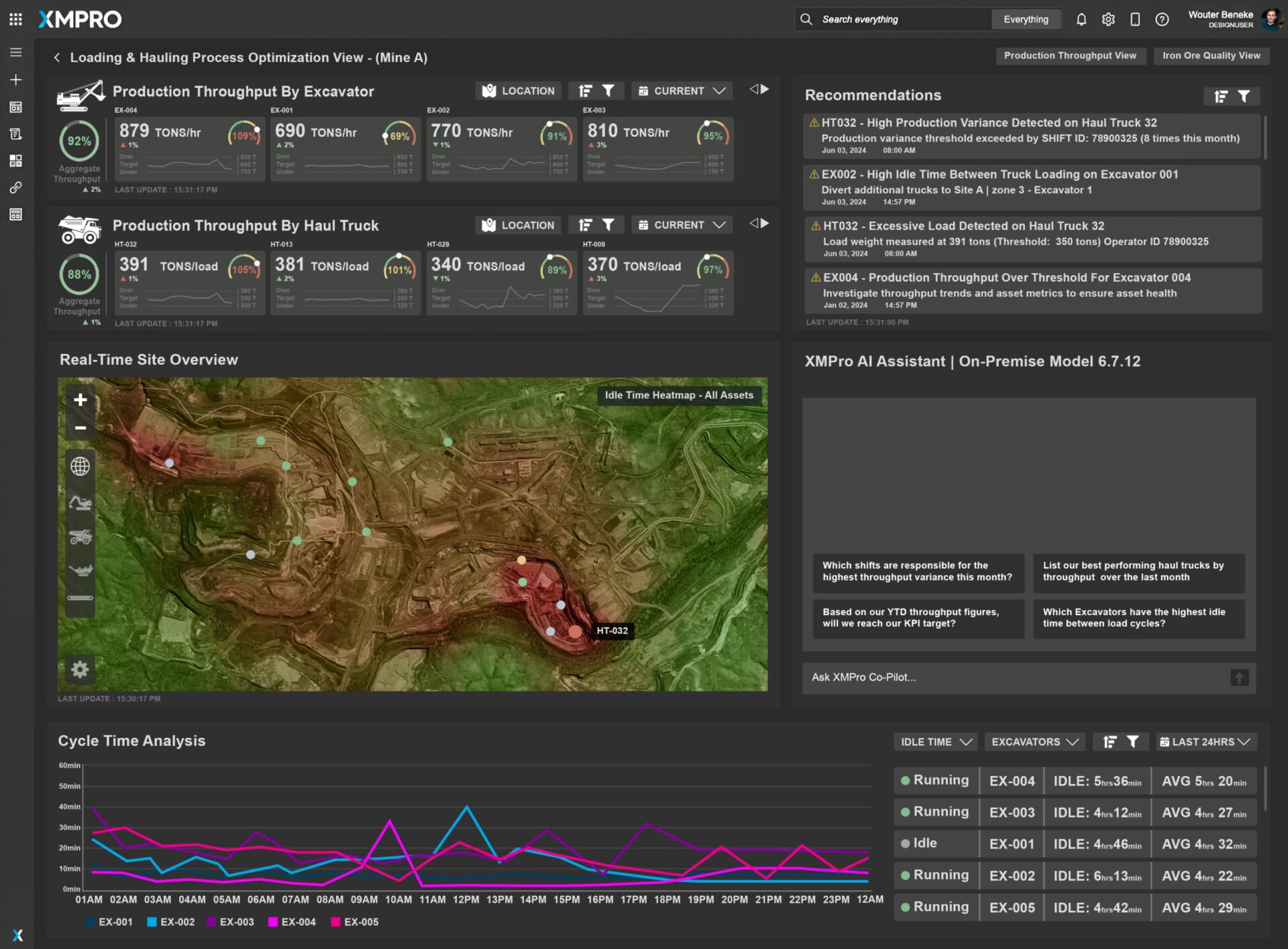
*Illustrative dashboards from the platform. Layout, signals and decision points are scoped per site.
Scope this for your operation.
Tell us about your fleet, your control maturity and the lever that matters most. We’ll map this use case to your starting point.
What this looks like in operation.
Higher productivity
Idle-time analysis and cycle-time bottleneck detection let planners reshape shifts and haul-truck pairings, not just monitor them.
Lower fuel and emissions cost
Per-asset fuel and CO₂ baselines turn the energy line into a leverable cost, with operator coaching anchored to numbers.
Predictable uptime
Component-level degradation surfaces days ahead of stoppage, moving work into planned outages rather than emergency response.
Built for these industries.
Other solutions you might explore.
Not a concept. In production.
XMPro is deployed at Tier 1 global operators across asset-intensive and mission-critical industries — delivering measurable results across predictive maintenance, process optimisation and operational intelligence.
Now pushing the frontier.
MAGS agents are achieving what no other industrial platform has demonstrated — sustained autonomous operations at enterprise scale.